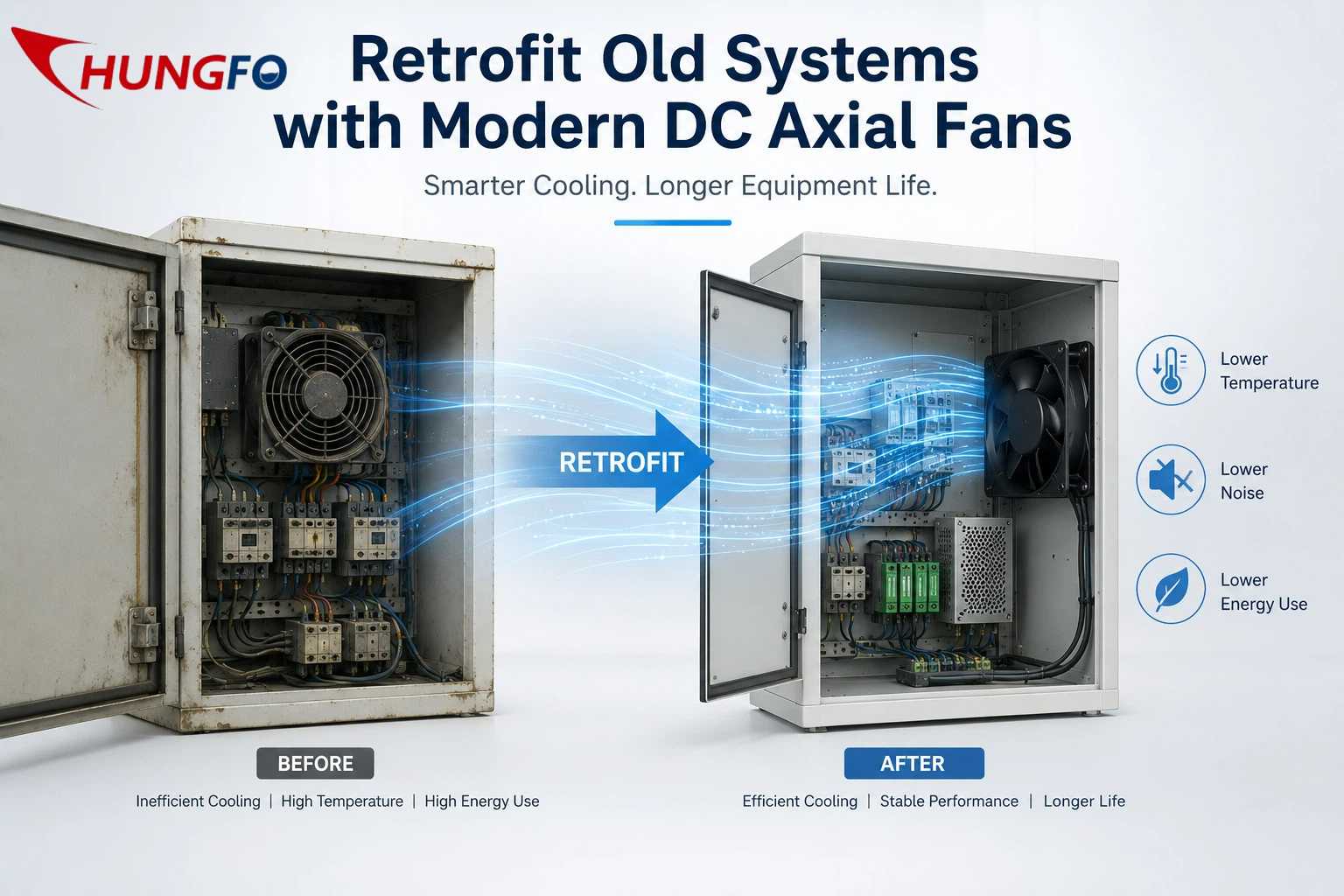
What Engineering Steps Are Needed to Retrofit an Old System with a Modern DC Axial Fan?
July 06 , 2026As global manufacturing continues to move toward intelligent automation, digitalization, and sustainable production, more companies are re-evaluating the value of upgrading existing equipment instead of replacing it entirely. In the past, when cooling systems became inefficient or equipment performance declined, purchasing new machinery was often considered the simplest solution. Today, however, rising equipment costs, increasing environmental awareness, and the growing demand for energy efficiency have encouraged manufacturers to extend the service life of existing systems through retrofitting. Among all upgrade options, improving the cooling system has become one of the most cost-effective engineering investments.
Throughout the first half of 2026, industries such as artificial intelligence infrastructure, electric vehicle charging, renewable energy storage, industrial automation, and smart manufacturing have continued to expand worldwide. As electronic components become more compact while delivering higher computing power, thermal management has become increasingly important. Excessive heat not only reduces equipment performance but also shortens the lifespan of critical components and increases maintenance costs. Consequently, replacing outdated cooling solutions with modern DC axial fans has become a practical strategy for improving system reliability while reducing operating expenses.
Although replacing a cooling fan may appear to be a simple maintenance task, a successful retrofit requires much more than removing an old fan and installing a new one. Every cooling system is part of a larger engineering design that involves airflow management, thermal distribution, electrical compatibility, installation constraints, and environmental conditions. Without proper planning, even a high-performance fan may fail to deliver the expected cooling results. Therefore, engineers should always evaluate the complete thermal system before selecting a replacement fan.
Many companies first consider a cooling system upgrade after experiencing operational problems. Control cabinets may begin overheating during summer months, servers may trigger thermal alarms under continuous workloads, telecommunications equipment may become unstable in high-temperature environments, refrigerated equipment may lose cooling efficiency, and outdoor vending machines may experience frequent electronic failures after prolonged exposure to sunlight. While these problems appear different on the surface, they often share one common cause: an aging cooling system that can no longer remove heat efficiently.
The cooling fan itself is frequently overlooked as equipment ages. After years of continuous operation, bearings gradually wear out, dust accumulates on the blades, motor efficiency decreases, and airflow is significantly reduced. At the same time, vibration and operating noise become more noticeable. Once cooling performance begins to decline, internal electronic components such as power supplies, capacitors, processors, and communication modules are forced to operate at higher temperatures for extended periods. This continuous thermal stress accelerates component aging and increases the likelihood of unexpected system failures.
Before beginning any retrofit project, engineers should first determine exactly what problem needs to be solved. Different applications require different cooling priorities. Industrial control cabinets often focus on maintaining consistent airflow throughout enclosed spaces. Medical equipment may require extremely quiet operation to improve the working environment. Energy storage systems demand reliable cooling during continuous high-load operation, while telecommunications equipment often requires intelligent fan speed control to maximize energy efficiency. Because every application has unique thermal characteristics, there is no universal replacement solution. A successful retrofit begins with understanding the actual cooling requirements of the equipment.
The first engineering step is identifying the major heat sources inside the equipment. Many legacy systems were originally designed years ago when electronic components consumed far less power than today's hardware. Over time, manufacturers may have upgraded processors, communication modules, controllers, or power supplies without redesigning the cooling system. As a result, localized hot spots often develop inside the enclosure. Engineers should perform thermal inspections using temperature sensors or infrared thermal imaging while the equipment is operating under full load. These measurements help identify where airflow should be concentrated rather than assuming that all areas require equal cooling.
Once the thermal profile has been established, the next step is carefully measuring the installation space. Many maintenance teams assume that replacing a fan simply requires matching the frame dimensions. In reality, successful installation depends on far more than overall size. Engineers should verify the frame thickness, mounting hole locations, airflow direction, cable routing, connector orientation, surrounding obstructions, and available installation clearance. Older equipment often follows different design standards than modern systems, and even small dimensional differences can affect airflow performance or make installation difficult. Careful mechanical evaluation prevents unnecessary modifications later in the retrofit process.
After confirming the installation dimensions, engineers should evaluate the electrical system. Many legacy machines still operate with AC cooling fans, while modern industrial equipment increasingly relies on DC-powered cooling solutions. Compared with traditional AC fans, DC fans offer lower power consumption, quieter operation, longer service life, smoother startup characteristics, and significantly greater control flexibility. For industrial automation equipment, energy storage systems, power supplies, and control cabinets, a 24v dc blower fan has become one of the most widely adopted cooling solutions. Stable 24-volt DC power allows precise fan speed adjustment through temperature control systems, reducing unnecessary energy consumption while maintaining optimal cooling performance under varying operating conditions.
Not every application, however, requires a 24-volt solution. Compact electronic products, portable instruments, medical devices, surveillance equipment, and embedded control systems frequently operate on 12-volt power supplies. In these applications, selecting a reliable 12v fan allows engineers to simplify electrical integration while maintaining stable cooling performance. When planning a retrofit, compatibility with the existing power supply should always be verified before selecting a replacement fan. In some cases, maintaining the original voltage architecture reduces both engineering costs and installation time, while in others, upgrading the electrical system may create opportunities for future intelligent control functions.
Choosing the correct fan involves much more than matching voltage or physical dimensions. One of the most common mistakes during retrofit projects is assuming that higher airflow automatically results in better cooling. In reality, airflow performance depends on the relationship between airflow volume, static pressure, and the internal airflow path of the equipment. If airflow encounters dense heat sinks, air filters, or narrow ventilation channels, insufficient static pressure may prevent cool air from reaching critical components. Consequently, engineers should always evaluate both airflow and static pressure together rather than selecting a fan based solely on maximum airflow ratings. This engineering analysis forms the foundation for every successful cooling system retrofit and determines whether the upgraded system will deliver reliable long-term performance.
After the mechanical installation and electrical compatibility have been confirmed, the most critical stage of the retrofit project begins: determining the actual cooling capacity required by the equipment. Many companies make the mistake of assuming that replacing an old fan with a higher-speed model will automatically solve overheating problems. In reality, thermal management is a comprehensive engineering discipline that requires balancing airflow, static pressure, air circulation, equipment layout, and operating conditions. Simply increasing fan speed may reduce temperature slightly, but it can also increase noise, consume more energy, and even create turbulent airflow that reduces overall cooling efficiency.
To select the correct fan, engineers typically estimate the total heat generated by electronic components, evaluate the maximum allowable operating temperature, and consider the ambient environment in which the equipment will operate. Equipment installed in outdoor cabinets, factory workshops, or tropical climates often requires significantly different cooling strategies than systems operating in climate-controlled facilities. If air filters, dense heat sinks, or complex internal structures restrict airflow, static pressure becomes just as important as airflow volume. A fan with high airflow but insufficient static pressure may fail to push cool air through these obstacles, leaving critical components exposed to excessive heat.
For this reason, many engineers now prefer larger fan sizes whenever installation space allows. A 120mm fan has become one of the most popular choices for industrial control cabinets, servers, telecommunications equipment, power supplies, energy storage systems, and intelligent manufacturing equipment. Compared with smaller fan sizes, a 120mm fan can move a greater volume of air while operating at a lower rotational speed. This combination provides several important advantages. Lower rotational speed reduces mechanical wear, decreases vibration, minimizes operating noise, and extends bearing life. At the same time, the larger blade diameter delivers stable airflow across a wider cooling area, making it particularly suitable for equipment that operates continuously throughout the day.
Airflow direction is another factor that is often underestimated during retrofit projects. Even a high-quality cooling fan cannot perform efficiently if the internal airflow path is poorly designed. Engineers should carefully study how cool air enters the enclosure, flows across heat-generating components, and exits the equipment. Dead zones, airflow recirculation, and blocked ventilation paths frequently reduce cooling efficiency without being immediately visible. By repositioning fans, redesigning ventilation openings, or adding simple air guides, engineers can often achieve greater thermal improvement than by installing a higher-powered fan alone. In many successful retrofit projects, optimizing airflow has produced significant temperature reductions while maintaining the same fan specifications.
Modern DC cooling fans also provide intelligent control functions that were unavailable in many older cooling systems. One of the most valuable features is PWM speed control. Instead of operating continuously at maximum speed, the fan automatically adjusts its rotational speed according to equipment temperature. During periods of low thermal load, the fan slows down, reducing energy consumption and operating noise. As temperatures increase, the fan accelerates automatically to provide additional cooling capacity. This dynamic control strategy improves overall energy efficiency while extending fan service life because the motor spends less time operating at maximum speed.
Another important feature is the FG (Frequency Generator) signal, which provides real-time speed feedback to the control system. Maintenance personnel can continuously monitor fan operation and immediately identify abnormal speed fluctuations before cooling performance is affected. In addition, the RD (Rotation Detection) alarm function can immediately notify the system if the fan stops unexpectedly or operates outside its specified speed range. These intelligent monitoring functions are widely used in servers, telecommunications infrastructure, industrial automation equipment, medical devices, and renewable energy systems where uninterrupted cooling is essential.
A practical example clearly illustrates the value of a well-designed cooling system retrofit. One manufacturer of outdoor vending machines experienced frequent overheating during summer operation. The machines were exposed to direct sunlight throughout the day, causing internal temperatures to rise well above their intended operating range. The original AC cooling fans could no longer provide sufficient airflow under these conditions, resulting in reduced cooling performance, increased compressor workload, and occasional electronic protection shutdowns.
After a complete engineering evaluation, the cooling system was redesigned using a 24v dc blower fan supplied by Chungfo Fan. Engineers optimized the internal airflow path, improved ventilation efficiency, and adjusted fan control parameters according to the equipment's thermal characteristics. After the retrofit, internal operating temperatures were significantly reduced, system stability improved during high ambient temperatures, operating noise decreased, and maintenance frequency was noticeably lower. The customer also reported improved overall energy efficiency and greater confidence in long-term outdoor operation.
Similar retrofit projects are now common across numerous industries. Medical equipment manufacturers frequently select reliable 12v fan solutions for compact diagnostic instruments where quiet operation and stable airflow are equally important. Industrial automation companies often choose larger 120mm fan models for electrical cabinets requiring continuous cooling under demanding factory conditions. Energy storage equipment manufacturers increasingly adopt intelligent 24v dc blower fan solutions that combine efficient airflow with programmable speed control. Each application has different cooling priorities, but all successful retrofit projects begin with a detailed engineering evaluation rather than simply replacing one fan with another.
It is equally important to remember that installation alone does not complete a retrofit project. Professional engineering teams should perform comprehensive validation tests before placing equipment back into continuous service. These tests typically include temperature rise measurements, airflow verification, current consumption analysis, acoustic testing, vibration evaluation, and long-term endurance testing under different operating loads. Such validation ensures that the redesigned cooling system performs as expected and provides valuable data for future maintenance planning. Thorough testing also helps identify installation issues or airflow restrictions that may not be immediately apparent during initial operation.
As a professional cooling fan manufacturer, Chungfo Fan is committed to providing reliable thermal management solutions for customers worldwide. With experienced engineering teams, advanced automated production lines, and comprehensive quality management systems, the company delivers cooling products designed for demanding industrial applications. Every cooling fan undergoes rigorous airflow testing, static pressure measurement, acoustic analysis, high- and low-temperature testing, salt spray testing, durability evaluation, and long-term reliability verification before leaving the factory. These strict quality control procedures ensure consistent performance in a wide variety of operating environments.
In addition to standard product lines, Chungfo Fan provides comprehensive OEM and ODM customization services. Customers can request customized frame dimensions, operating voltages, rotational speeds, PWM control, FG speed feedback, RD alarm functions, waterproof and dustproof protection levels, connector configurations, and application-specific cooling solutions. Today, Chungfo Fan products are widely used in industrial automation, telecommunications, medical equipment, refrigeration systems, cold-chain logistics, energy storage, EV charging infrastructure, intelligent vending machines, and numerous other electronic applications requiring dependable thermal management.
Looking ahead, equipment retrofitting will continue to play an increasingly important role as manufacturers pursue higher efficiency, lower operating costs, and more sustainable production. Upgrading a cooling system with a modern DC axial fan is no longer simply a maintenance decision; it is a long-term engineering investment that improves reliability, extends equipment life, reduces energy consumption, and enhances overall system performance. By combining careful engineering analysis, appropriate product selection, optimized airflow design, and comprehensive testing, manufacturers can significantly improve the performance of legacy equipment without replacing entire systems. As thermal management technologies continue to evolve, Chungfo Fan will remain dedicated to developing innovative, reliable, and energy-efficient cooling solutions that help customers around the world achieve safer, smarter, and more sustainable equipment operation.