屋外用冷風扇のIP68防水シールの劣化をどのように防ぐことができますか?
September 07 , 2026屋外用空冷ファンは、雨、湿度、粉塵、温度変化、塩水噴霧などの過酷な環境条件下で連続運転する必要のある機器でますます広く使用されています。通信機器キャビネット、屋外電源装置、EV充電機器、太陽光発電インバーター、産業用制御盤、冷凍システム、農業機器、LEDディスプレイなど、多くのシステムは強制空冷によって熱を除去しています。しかし、これらのシステムを屋外に設置する場合、冷却性能は信頼性の要素の一つにすぎません。ファンが長年にわたって水や粉塵に対する保護性能を維持できるかどうかも、同様に重要です。
1IP68規格のファンこの製品は、粉塵や水の侵入に対して非常に高いレベルの保護を提供するように設計されています。ただし、IP68等級は、シーリングシステムが永久に変化しないことを保証するものではありません。屋外での使用は、継続的な機械的、熱的、化学的、および環境的ストレスをもたらします。時間の経過とともに、シールは弾力性を失い、接着剤は劣化し、ケーブル引き込み口は脆弱になり、ハウジングの接合部は寸法変化を起こし、直接雨水が機器内部に入り込まなくても結露によって湿気が発生する可能性があります。
つまり、屋外用空冷ファンをIP68防水シールの劣化から保護するには、単にIP68ラベルの付いたファンを選ぶのではなく、包括的な信頼性戦略が必要となる。
機器メーカーやエンジニアにとって最も重要な問題は、ファンが新品時にIP68試験に合格できるかどうかだけでなく、ファンのシール構造、材料、電気部品、ベアリング、ケーブル接続、設置環境が、想定される耐用年数を通して信頼性の高い性能を発揮し続けることができるかどうかである。
屋外用冷却ファンにとって、IP68とは具体的に何を意味するのでしょうか?
IPコードは、筐体が固体物体と水に対して提供する保護レベルを表すために使用されます。最初の数字は固体粒子に対する保護、2番目の数字は水に対する保護を表します。IP68は、特定の試験条件下での水中浸漬に対する保護に加え、高いレベルの粉塵保護性能を示します。IP68の性能を示す正確な浸漬条件は、製造元が宣言する試験条件および適用される要件によって異なります。
この違いは、屋外用扇風機を選ぶ際に重要です。
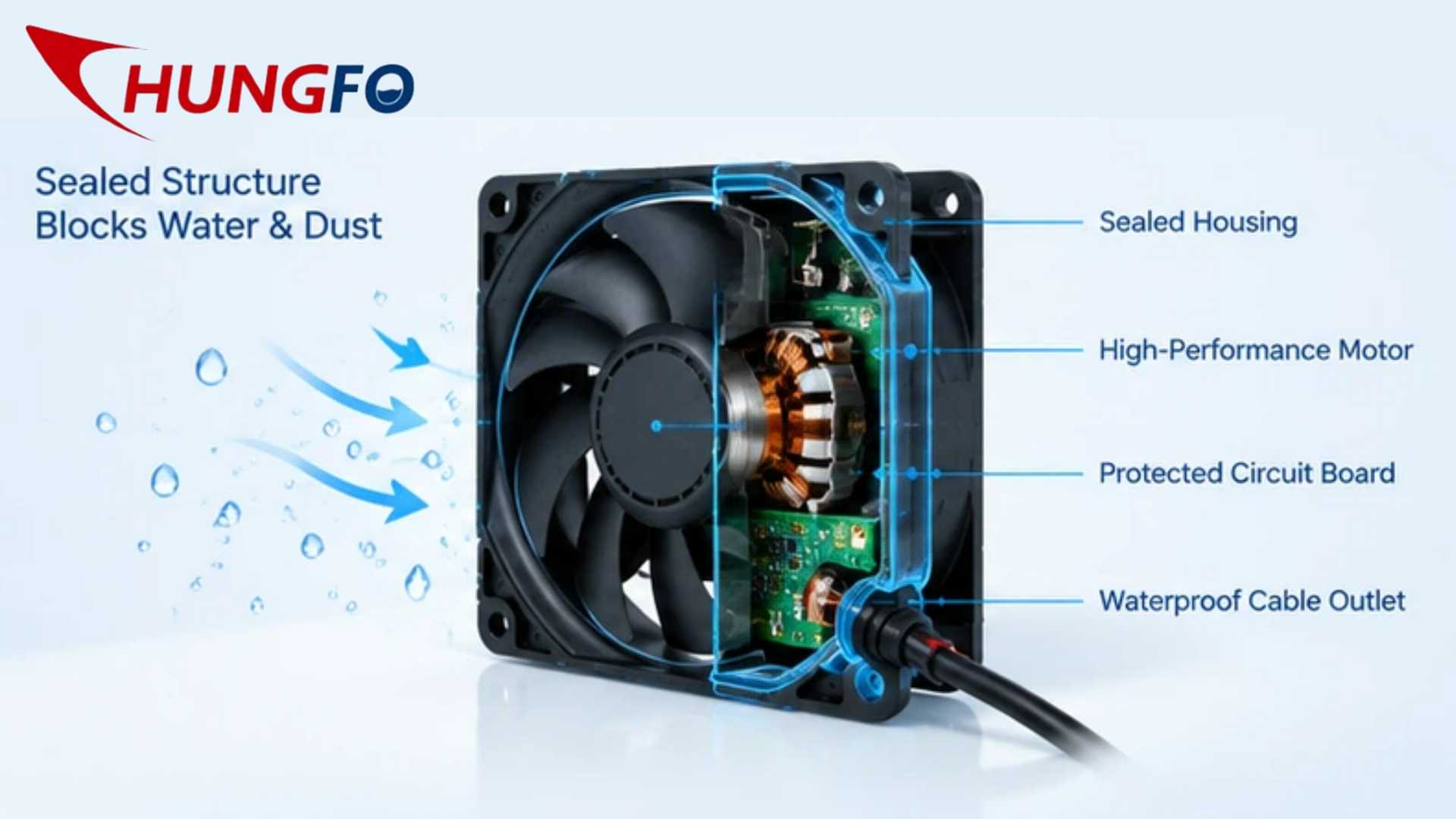
IP68規格のファンは、単にゴム製のカバーを被せただけの従来型のファンではありません。確実な保護性能を実現するためには、メーカーは通常、複数の潜在的な浸水経路を制御する必要があります。これには、筐体の接合部、ケーブル出口、コネクタ、モーター構造、回路基板、ベアリング部、その他のインターフェースなどが含まれます。
適切に設計された防水ファンは、密閉型筐体構造、樹脂保護、コンフォーマルコーティング、防水ケーブル出口、特殊ベアリング、耐腐食性材料、そして厳密に管理された製造プロセスなどを組み合わせて使用できます。業界の事例では、巻線や回路基板を外部環境から隔離するために、ポッティングやカプセル化が用いられていることが示されています。
しかしながら、製造試験中に測定された保護レベルは、特定の時点における特定の条件下における値です。屋外機器は、繰り返しの温度変化、振動、紫外線への曝露、化学物質による汚染、機械的ストレスにさらされます。これらの要因により、シーリング材の特性は徐々に変化する可能性があります。
そのため、長期的な保護はシステムレベルの工学的問題として捉えるべきである。
IP68防水シールはなぜ経年劣化するのか?
屋外冷却システムの設計において最もよくある間違いは、防水性が製品の恒久的な特性であると考えることです。実際には、あらゆるシーリングシステムは環境の影響を受けます。
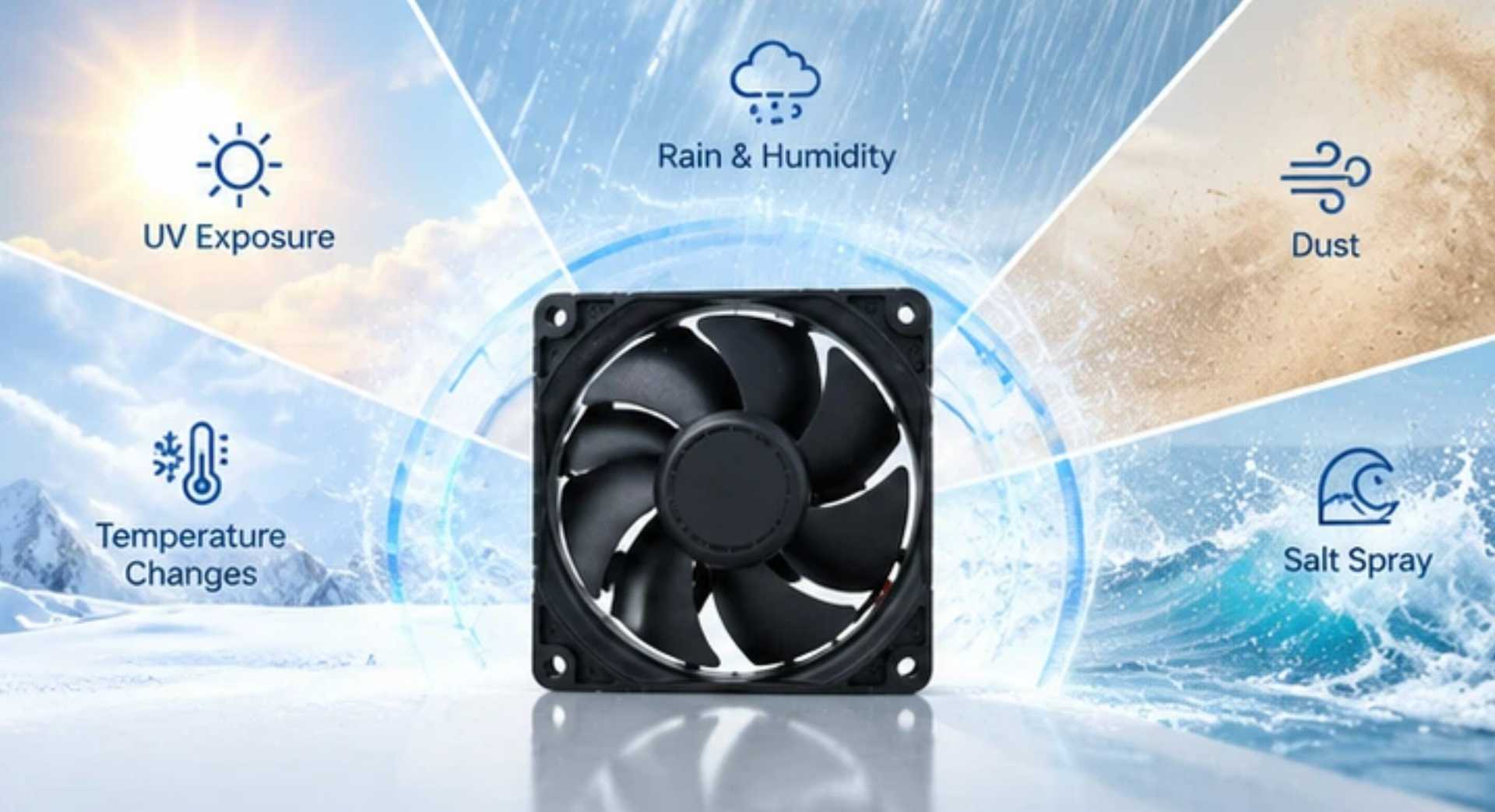
温度変化は最も重要な要素の一つです。
屋外用ファンは、夜間の冷え込み、日中の直射日光、機器表面の高温、突然の雨、季節的な気温変化などにさらされる可能性があります。プラスチック製の筐体、ゴム製のシール、接着剤、金属部品、樹脂材料などは、必ずしも同じ速度で膨張・収縮するとは限りません。
繰り返し膨張と収縮を繰り返すと、界面にストレスがかかる可能性がある。
シールが硬くなったり、柔らかくなったり、圧縮されたり、膨張したり、永久変形したりすると、接触圧力が徐々に低下する可能性があります。わずかな変化ではすぐに目に見える漏れが発生しないかもしれませんが、繰り返し環境にさらされることで水分が侵入する経路ができてしまう可能性があります。
熱サイクルも重要です。屋外の電子機器筐体では圧力変化が生じる可能性があるからです。内部の空気が温まって膨張し、その後冷えて収縮すると、筐体内で圧力変動が発生します。長期間にわたってこのようなサイクルが繰り返されると、弱いシール面に負担がかかる可能性があります。屋外密閉型筐体に関する工学的研究では、熱膨張と熱収縮がシール不良や結露問題の原因となる可能性があることが明らかになっています。
紫外線への曝露も懸念事項の一つです。
屋外に設置されたファンは、数千時間にわたって日光にさらされる可能性があります。材質によっては、紫外線によって変色、脆化、表面のひび割れ、機械的特性の低下などが起こることがあります。そのため、ファンの筐体やシール構造が直射日光にさらされる場合は、屋外での使用に適した材質を選ぶことが重要です。
湿度は、長期的な課題の一つとなる。
湿度の高い環境では、必ずしも水との直接接触がなくても信頼性の問題が発生する可能性があります。湿気は、脆弱なインターフェース、コネクタ、ケーブル構造、または微細な欠陥を通して浸透する可能性があります。また、高湿度は金属部品や電子接点の腐食を促進することもあります。
塩水噴霧は特に攻撃的な場合がある。
沿岸地域付近に設置された屋外機器は、空気中の塩分粒子や湿気にさらされる可能性があります。塩分汚染は、金属部品、コネクタ、ファスナー、電気接点の腐食を促進する可能性があります。そのため、環境ファンメーカーは、塩水噴霧や湿気にさらされる用途向けに、特別な耐腐食設計を提供することがよくあります。
埃は問題を悪化させる可能性がある。
シール部や機械的な接合部周辺には、粉塵が蓄積することがあります。粉塵に研磨性粒子や化学的に活性な粒子が含まれている場合、繰り返しの動きや振動によってシール面が徐々に損傷を受ける可能性があります。粉塵が水分と混ざると、除去がより困難な堆積物を形成することがあります。
ファンハウジングはどのようにして防水シールを保護するのでしょうか?
ファンハウジングは、環境汚染に対する最初の主要な防御線である。
堅牢な屋外用ファンは、不要な開口部を最小限に抑え、密閉性を確保した筐体構造を備えているべきです。開口部が少ないほど、信頼性の高い環境保護を維持しやすくなります。
ハウジングの接合部は慎重に設計する必要がある。
接触面、ガスケットの圧縮、公差、および締結方法が適切に管理されていない限り、単純な機械的接合では十分な長期保護が得られない可能性があります。設計によっては、ガスケット、シーリング材、樹脂充填、ポッティング、オーバーモールディング、またはその他の技術が使用される場合があります。
目的は単に筐体を開けにくくすることではない。振動や温度変化のサイクル下でも機械的完全性を維持しながら、水に対する安定したバリアを形成することにある。
特に高い環境保護性能が求められる用途では、内部の電子部品をコーティングや封止によって保護することもあります。IP68規格に準拠したファンの中には、樹脂ベースの技術を用いて、繊細な巻線や回路基板を水や湿気から隔離する設計もあります。
この方法は、さらなる保護層を提供する。
外装に小さな欠陥が生じた場合でも、内部を密閉することで、湿気が繊細な電子部品に到達する可能性を低減できます。
ケーブルコンセントが重要な防水ポイントとなるのはなぜですか?
多くのエンジニアはファンハウジングには細心の注意を払うが、ケーブル出口を軽視しがちだ。
ケーブルは保護された内部領域から外部環境へと通過する必要がある。この移行によって、避けられないインターフェースが生じる。
ケーブル出口の設計が不十分な場合、水がケーブルに沿って、あるいはケーブル引き込み口周辺の隙間から浸入する可能性があります。
そのため、防水ファンの設計では、成形されたケーブル出口、シーリング材、ケーブルグランド、防水コネクタ、またはその他の制御されたシーリング方法が用いられることが多い。
ケーブルの材質自体も重要です。
屋外用ケーブルは、温度変化、紫外線、湿気、曲げ、振動、そして場合によっては化学物質にも耐えなければなりません。屋内で優れた性能を発揮するケーブルでも、屋外では必ずしも同じように長期的に信頼できるとは限りません。
したがって、ケーブルとファンの接続部は、完全な防水システムの一部として評価されるべきである。
保護されていない外部コネクタを備えた高品質のIP68ファンを使用すると、システム全体に弱点が生じる可能性があります。ファン自体は優れた環境保護性能を備えているかもしれませんが、最終的な機器アセンブリはそうではないかもしれません。
結露はIP68ファンの信頼性にどのような影響を与えるのか?
防水と結露は、全く異なる問題である。
直接的な水の浸入は、開口部や損傷したシールから液体の水が侵入することによって発生します。結露は、空気中に存在する水分が温度変化によって液体の水に変化することによって発生します。
この区別は、屋外用電子機器において特に重要である。
密閉された筐体内には湿った空気が含まれている場合があります。日中の運転中は、内部部品によって空気が加熱されます。夜間は、機器が冷却されます。内部温度が露点に達すると、温度の低い表面に水滴が結露することがあります。
したがって、たとえ密閉性の高い筐体であっても、熱設計が適切に管理されていない場合は、内部に湿気が侵入する可能性がある。
したがって、屋外用ファンシステムでは、水の浸入防止と湿気対策の両方を考慮する必要がある。
筐体設計によっては、通気性のあるメンブレンを使用することで、圧力の均一化を図りながら水の浸入を抑えることができます。ただし、追加の通気部品は筐体の全体的な環境保護性能に影響を与える可能性があるため、このようなソリューションは慎重に選択する必要があります。IP67およびIP68規格の筐体に関する設計ガイドラインでは、長期的な信頼性を確保する上で、圧力の均一化と結露対策が一般的に重視されています。
温度変化はファンシールにどのような影響を与えるのか?
温度変化の繰り返しは、一度の高温現象よりも、長期的に見るとより大きなダメージを与えることが多い。
電気キャビネット内部で屋外冷却ファンが作動している様子を想像してみてください。日中は太陽光によってキャビネット内の温度が上昇します。内部の電子部品が熱を発生するため、ファンは高速で回転します。夜間になると、システムは急速に冷却されます。
このサイクルは毎日起こる可能性がある。
筐体は膨張と収縮を繰り返す。シール材はそれぞれ異なる反応を示す。接着剤には応力がかかる。ケーブル被覆はわずかに寸法が変化する。ベアリング内部の潤滑剤は温度変化に反応する。電子部品も繰り返し熱応力を受ける。
Over thousands of cycles, small changes can accumulate.
This is why outdoor fan qualification should consider the actual operating temperature range rather than only the nominal room-temperature condition.
Selecting a fan designed for the expected temperature range can significantly improve reliability.
The thermal design should also consider the difference between ambient temperature and the temperature inside the equipment. A fan operating in a 40°C outdoor environment may be exposed to a considerably higher internal temperature if the enclosure receives solar radiation or contains high-power electronics.
A suitable outdoor fan therefore needs both environmental protection and thermal capability.
How Can Material Selection Reduce Seal Degradation?
Material selection is one of the most effective ways to improve long-term environmental reliability.
Different rubber, plastic, resin, adhesive, and cable materials behave differently under ultraviolet radiation, heat, humidity, chemicals, and salt exposure.
For sealing applications, engineers should consider compression set, temperature resistance, chemical compatibility, water resistance, and aging characteristics.
For fan housings, material selection should consider mechanical strength, dimensional stability, flame resistance, corrosion resistance, ultraviolet exposure, and operating temperature.
For bearings, moisture resistance and lubricant stability are important.
For cables, flexibility, insulation performance, temperature resistance, and environmental durability should be evaluated.
A waterproof fan should therefore be selected as a complete engineered system rather than simply according to its external appearance.
How Important Are Bearings In An Outdoor Cooling Fan?
The waterproof seal protects electrical components, but the bearing system determines how reliably the impeller can rotate.
Outdoor environments can accelerate lubricant degradation and corrosion if the bearing structure is not suitable for the application.
Water exposure can be particularly damaging to conventional bearing systems.
A bearing that performs well in a clean indoor cabinet may experience different conditions in an outdoor agricultural machine, coastal power system, or industrial enclosure.
For long-life outdoor operation, engineers should consider bearing construction, lubricant characteristics, operating temperature, expected rotational speed, vibration, and environmental exposure.
Some manufacturers offer IP68 fans with specially protected ball bearings or other bearing solutions designed for demanding conditions.
The correct bearing selection also helps prevent secondary failures. If a bearing begins to develop excessive friction, the motor may consume more power, the fan may produce more heat, airflow can decline, and vibration can increase.
Therefore, bearing reliability is closely connected with the entire cooling system.
How Can You Protect An Outdoor Fan From Salt Spray?
Coastal installations require special attention.
Salt mist can reach outdoor equipment even when the fan is not directly exposed to seawater. Tiny salt particles can settle on surfaces and remain there when humidity is high.
Over time, salt contamination can accelerate corrosion.
The best strategy is to combine corrosion-resistant materials with appropriate sealing and, where necessary, additional surface protection.
Metal components should be selected according to the expected environmental conditions. Electrical connectors should have suitable environmental protection. The fan housing should prevent unnecessary exposure of sensitive components.
In particularly demanding applications, salt spray testing can provide useful information about material and surface durability.
A fan that is technically waterproof but uses materials that corrode rapidly may still have poor long-term reliability.
Therefore, IP68 should not be treated as a substitute for corrosion resistance.
How Can Installation Prevent IP68 Seal Damage?
Even the best waterproof fan can fail prematurely if it is installed incorrectly.
Mechanical stress is one of the most common installation-related problems.
If the fan frame is mounted against an uneven surface, excessive force can deform the housing. If screws are tightened unevenly, the sealing interface may experience uneven compression.
Cable routing is another important factor.
A cable should not be bent sharply near the sealed outlet unless the design specifically allows it. Excessive bending can place continuous mechanical stress on the cable entry.
The fan should also be positioned so that water does not remain unnecessarily around vulnerable interfaces.
If the application involves pressure washing, the direction and pressure of the water should be evaluated rather than assuming that an IP68 rating means unlimited resistance to every cleaning condition.
Installation instructions should therefore be treated as part of the waterproofing design.
Why Should You Avoid Relying Only On The IP68 Label?
The IP68 rating is valuable, but it is only one part of the product specification.
Two fans can both carry an IP68 designation while having different designs, materials, operating temperature ranges, expected lifetimes, corrosion resistance, bearing systems, and testing conditions.
For an outdoor application, engineers should ask additional questions.
What temperature range can the fan operate in?
What materials are used for the housing and sealing components?
How is the circuit board protected?
How is the cable outlet sealed?
What bearing technology is used?
Has the fan been tested under temperature cycling?
Has it been evaluated for salt spray?
What is the expected service life?
What are the airflow and static pressure characteristics?
Can the manufacturer provide reliability data?
These questions help transform IP68 from a marketing specification into a meaningful engineering parameter.
How Should You Test An Outdoor IP68 Fan?
Testing should simulate the actual environment as closely as possible.
A basic water ingress test is useful, but long-term reliability requires more than one test.
Temperature cycling can evaluate the effect of repeated expansion and contraction.
Humidity testing can help evaluate moisture resistance.
Salt spray testing can provide information about corrosion resistance.
Vibration testing can evaluate mechanical integrity.
High-temperature operation can reveal problems associated with seals, bearings, electronics, and lubricants.
Low-temperature testing can reveal changes in material flexibility and starting behavior.
Combined environmental testing can be even more valuable because real outdoor conditions rarely occur independently.
A fan may experience high temperature, humidity, vibration, and electrical load at the same time.
Manufacturers with appropriate testing capabilities can use environmental chambers, wind tunnel systems, pressure testing equipment, noise testing facilities, and other equipment to evaluate fan performance.
The purpose of testing should not be simply to obtain an IP rating. The objective should be to understand how the product behaves throughout its expected service life.
How Does Airflow Design Influence Waterproof Fan Reliability?
Waterproofing and airflow performance must be balanced.
Adding sealing structures, protective layers, or encapsulation can increase resistance to heat transfer or affect the internal thermal path.
At the same time, excessive restriction of the airflow path can reduce cooling performance.
An outdoor fan should therefore be selected according to the actual airflow and static pressure requirements of the equipment.
For example, asmall 12 volt dc mini fanmay be appropriate for a compact outdoor electronic module, but it may not provide sufficient airflow for a large industrial cabinet with high heat generation.
The key is not simply choosing the fan with the highest RPM.
A fan operating against high system resistance needs sufficient static pressure.
A fan operating in a relatively open airflow path may benefit more from high free-air volume.
This is why the fan performance curve should be considered during product selection.
The fan should be matched to the system operating point rather than selected based only on dimensions.
What Role Does Speed Control Play In Outdoor Fan Life?
Speed control can also contribute to long-term reliability.
If the fan operates at maximum speed continuously, it may generate more noise, vibration, power consumption, and mechanical stress than necessary.
If the equipment temperature varies significantly, variable-speed control can allow the fan to operate according to the actual cooling requirement.
PWM control is one possible method for controlling compatible DC fans.
By reducing unnecessary high-speed operation, the system may reduce mechanical stress and energy consumption.
However, speed control must be properly designed because operating a fan outside its recommended control range can affect starting reliability, acoustic performance, and motor temperature.
The appropriate control strategy depends on the fan design and the equipment requirements.
Choosing The Right Outdoor Fan For Different Applications
Outdoor telecom cabinets often operate continuously and can experience rain, dust, temperature fluctuations, and solar heating. A sealed DC cooling fan can help remove heat while limiting the risk of water and dust entering sensitive areas.
EV charging equipment presents another demanding application. Power electronics can generate substantial heat while the charger is installed outdoors. Waterproof cooling fans can help maintain thermal performance while improving environmental protection.
Solar inverter cabinets can also benefit from environmental fan solutions. Inverter electronics operate under varying outdoor temperatures, and reliable thermal management is essential for stable operation. Water ingress and condensation can create significant risks for electronic components, making environmental protection especially important.
Industrial automation equipment may be exposed to dust, humidity, oil mist, and vibration. The fan must therefore be selected according to the complete industrial environment rather than simply the expected temperature.
Agricultural equipment can face mud, moisture, dust, chemicals, and outdoor temperature fluctuations. In such conditions, corrosion resistance and mechanical durability become particularly important.
Marine and coastal equipment has an even stronger requirement for salt resistance.
Compact electronics may require a small waterproof fan. A Rocket RC Fan concept, for example, may be useful when discussing compact airflow requirements in remote-controlled equipment, hobby electronics, or small mechanical systems, but the exact environmental rating must always be confirmed from the actual product specification.
Why Should Manufacturers Consider Different Fan Structures?
Not every outdoor cooling requirement needs the same fan architecture.
Axial fans are widely used when a relatively large volume of air needs to move through a system with moderate resistance.
Centrifugal fans can be advantageous when the system requires stronger pressure against resistance.
Compact blowers may be useful when airflow needs to be redirected through a narrow duct or confined space.
An ac dc small fan can be useful when equipment requirements involve different power supply architectures or when the application needs a compact fan platform with flexible electrical configurations.
However, the electrical input should always be matched to the actual fan design.
A12V DC fan, a 24 V DC fan, and an AC fan should not be treated as interchangeable simply because their dimensions are similar.
How Can China Chungfo Fan Help With Outdoor Cooling Fan Selection?
For manufacturers developing outdoor electronic equipment, the fan is not an isolated component. It is part of the thermal and environmental protection system.
China Chungfo Fan focuses on cooling fan solutions for different equipment applications and can support requirements involving DC fans, AC fans, axial fans, centrifugal fans, blowers, and customized fan configurations.
The selection process should begin with the actual operating conditions.
The required voltage, airflow, static pressure, installation space, operating temperature, expected lifetime, noise requirement, environmental exposure, and protection level should all be considered together.
For an outdoor project, the application environment should be clearly described.
For example, a fan installed inside a sheltered outdoor cabinet has different requirements from a fan directly exposed to rain. A coastal application has different requirements from an inland factory. A solar inverter exposed to direct sunlight has different thermal conditions from an indoor control cabinet.
The more accurately the environment is defined, the more accurately the fan can be selected.
How Can You Build A Long-Term IP68 Protection Strategy?
The most effective strategy is to treat waterproofing as a lifecycle issue.
Start with the environment.
Identify rain, humidity, dust, salt, ultraviolet radiation, chemicals, vibration, temperature range, and cleaning requirements.
Then identify the thermal requirement.
Determine how much heat the equipment generates and where that heat needs to move.
After that, select the fan structure.
Choose axial, centrifugal, blower, or another design according to airflow resistance and available installation space.
Then evaluate the protection structure.
Look at housing sealing, cable exits, connectors, internal electronics protection, bearings, materials, and corrosion resistance.
Next, consider installation.
Make sure the mounting surface, screws, cable routing, drainage, and airflow direction do not compromise the sealing system.
Finally, test the complete system.
Do not test only the fan in isolation when the real application depends on the interaction between the fan and the equipment enclosure.
This system-level approach can greatly reduce the risk of premature waterproofing failure.
Maintenance Recommendations For Outdoor IP68 Fans
Even a highly protected fan should be included in the equipment maintenance plan.
The fan should be inspected periodically for visible damage, abnormal noise, vibration, corrosion, cable damage, and contamination.
The airflow path should remain clear.
Dust and debris can reduce airflow and increase motor load. If the fan is installed behind a protective grille or filter, that component should also be inspected.
In coastal environments, corrosion should be monitored more frequently.
If unusual vibration or noise appears, the fan should be evaluated before the problem becomes a complete failure.
Maintenance intervals should be based on the application environment rather than a universal schedule.
A clean indoor installation may require minimal inspection, while a coastal industrial installation may require much more frequent checks.
Common Mistakes When Using IP68 Outdoor Fans
One common mistake is assuming that IP68 means the fan can be exposed to any water condition indefinitely.
Another mistake is ignoring condensation.
A third mistake is installing an IP68 fan with a non-waterproof connector.
Another problem is selecting the fan based only on size.
Some engineers also focus on free-air airflow without considering system resistance.
Ignoring temperature is another common error. A fan may survive a short high-temperature event but have a much shorter service life if operated continuously at elevated temperatures.
Finally, some projects evaluate the fan but do not evaluate the complete enclosure.
The final equipment protection level depends on the complete system.
Conclusion
Protecting an outdoor air cooling fan from IP68 waterproof seal degradation requires much more than choosing a fan with a high IP rating.
The long-term reliability of an outdoor fan depends on sealing design, material selection, housing construction, cable protection, bearing technology, corrosion resistance, temperature management, condensation control, installation quality, and environmental testing.
IP68 provides an important level of environmental protection, but it should be viewed as one part of a complete engineering strategy. Real outdoor applications expose cooling fans to thousands of hours of thermal cycling, humidity, rain, dust, vibration, sunlight, and sometimes salt mist. These conditions can gradually influence sealing materials and mechanical components.
The best approach is to select a fan according to the actual operating environment, not simply according to a product label.
For compact electronics, a small waterproof fan may provide an effective balance between airflow and protection. For larger cabinets, engineers may need higher airflow and static pressure. For high-humidity or coastal environments, corrosion resistance and internal electrical protection become increasingly important.
China Chungfo Fan can provide different cooling fan solutions according to application requirements. By combining suitable airflow performance with appropriate environmental protection, equipment manufacturers can create cooling systems that are more reliable, durable, and suitable for long-term outdoor operation.
The key principle is simple: IP68 protection should not be treated as a single specification. It should be treated as a long-term reliability system.
FAQ
What does IP68 mean for an outdoor cooling fan?
IP68 indicates a high level of protection against dust and water ingress under specified testing conditions. The exact immersion requirements should be confirmed from the manufacturer's test specification.
Does IP68 mean a fan will never leak?
No. IP68 describes performance under defined test conditions. Long-term outdoor exposure can affect seals, cables, materials, connectors, and other components.
Why do outdoor fan seals degrade?
Temperature cycling, ultraviolet exposure, humidity, chemicals, salt mist, vibration, mechanical stress, and material aging can gradually affect sealing performance.
Can condensation occur inside an IP68 enclosure?
Yes. Condensation can occur when humid air inside an enclosure cools below its dew point. Waterproofing and condensation management should therefore be considered separately.
Is IP68 enough for coastal applications?
Not necessarily. Coastal environments can involve salt mist and corrosion. Material selection, connector protection, corrosion resistance, and appropriate environmental testing should also be considered.
Why is the cable outlet important?
The cable outlet creates a transition between the internal protected area and the outside environment. Poorly protected cable entries can become a potential water ingress path.
Should an IP68 fan be tested for salt spray?
For coastal or salt-exposed applications, salt spray or other corrosion testing can be useful for evaluating long-term environmental durability.
適切な屋外用冷却ファンを選ぶにはどうすればよいですか?
まず、電圧、風量、静圧、温度範囲、設置スペース、騒音、期待寿命、湿度、粉塵、水濡れ、振動、腐食条件などを考慮して、ファンの構造と保護等級を選定します。
小型の12ボルトファンは屋外機器に適していますか?
風量、静圧、温度範囲、保護等級、環境耐久性が用途要件を満たしていれば、小型機器に適しています。12ボルトDCミニファンは、電圧と寸法だけで選定すべきではありません。
防水ファンは電気自動車の充電器で使用できますか?
はい。防水仕様または環境保護仕様の冷却ファンは、その風量、熱性能、電気特性、および環境定格が用途に適している場合、屋外のEV充電設備に使用できます。
空気の流れとIP68保護等級、どちらがより重要でしょうか?
どちらも重要です。防水性能に優れていても風量が不十分なファンでは、機器を適切に冷却できません。また、十分な環境保護対策が施されていない高性能ファンは、屋外では早期に故障する可能性があります。
中国忠仏扇は、屋外扇風機プロジェクトをどのように支援できるのでしょうか?
中国忠佛扇は、用途に応じた電圧、風量、圧力、寸法、温度、環境条件、その他の要件を評価し、メーカーが適切な冷却ファンソリューションを特定できるよう支援します。