
How Does A Cross Flow Cooling Fan Ensure Uniform Airflow In Medical Incubators?
September 18 , 2026Medical incubators require a highly controlled internal environment where temperature, humidity, airflow and other operating conditions must remain stable. In these systems, airflow is not simply a matter of moving air from one point to another. The circulation pattern determines how efficiently conditioned air is distributed, how evenly heat is transferred and how effectively temperature differences are reduced throughout the chamber.
A cross flow cooling fan can play an important role in this process because of its ability to generate a broad airflow across a relatively long outlet. Unlike a conventional axial fan that primarily moves air along the axis of its impeller, a cross flow fan can distribute air across a wider area. This characteristic makes the technology suitable for equipment where a compact structure and relatively uniform air distribution are required.
In medical incubator applications, however, fan selection cannot be separated from the overall airflow system. The fan, air inlet, heating element, air duct, outlet geometry, chamber structure, temperature sensors and control algorithm must work together. The purpose of the fan is therefore not simply to provide maximum airflow. Instead, it should provide the appropriate airflow volume, pressure, velocity and distribution pattern for the specific incubator design.
Why Is Uniform Airflow Important In Medical Incubators?
The internal environment of a medical incubator needs to remain stable because temperature variations can directly affect the controlled environment inside the chamber. If some areas receive significantly more heated air than others, localized hot spots and cold zones can develop.
Uniform airflow helps reduce this problem by continuously mixing and redistributing conditioned air. When air is circulated properly, heat generated by the heating system can be transported more evenly throughout the chamber. At the same time, air that has lost heat can return to the circulation path and be conditioned again.
This creates a continuous airflow loop.
Conditioned air leaves the heating and airflow section, enters the chamber, travels through the intended circulation path, returns to the inlet region and is then recirculated.
The effectiveness of this loop depends heavily on the airflow pattern. A fan that produces a strong but highly concentrated jet may create excessive velocity in one area while leaving another area with insufficient circulation. For an incubator, this can be less desirable than a broader and more controlled airflow distribution.
This is one reason cross flow technology is attractive for certain incubator designs.
Modern infant incubators are subject to specific safety and essential performance requirements. IEC 60601-2-19 addresses infant incubators and includes requirements related to temperature stability and temperature uniformity. The standard recognizes that controlled and measurable environmental performance is an essential part of incubator operation.
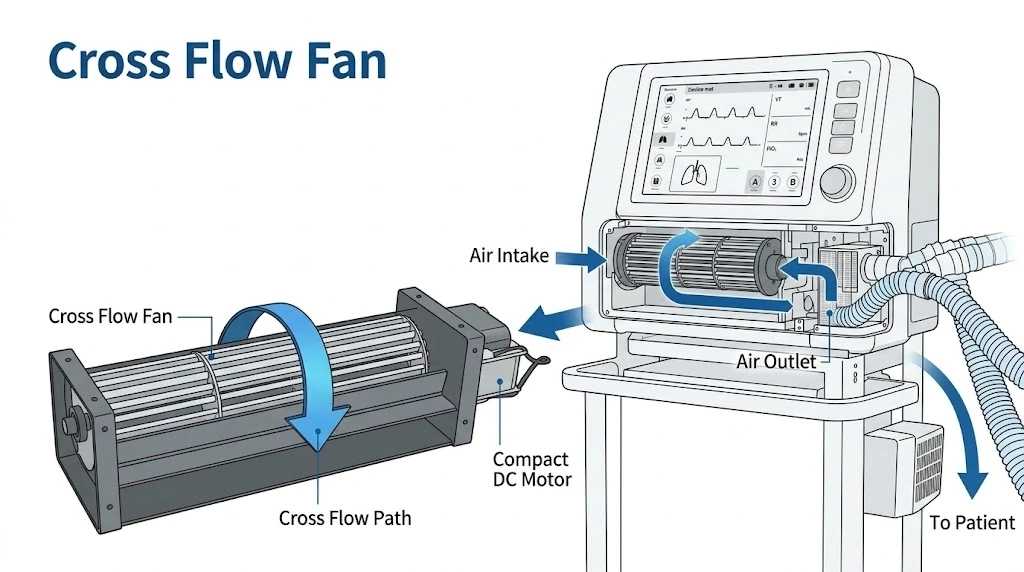
How Does A Cross Flow Fan Work?
A cross flow fan, sometimes called a tangential fan, generally uses a long cylindrical impeller containing multiple blades. Air enters the impeller region and is redirected through the rotating blade structure and housing.
The important characteristic is the width of the airflow.
Instead of producing airflow from a relatively small circular outlet, the long impeller can generate an elongated air stream extending across much of the fan length. This makes the design particularly useful when the equipment requires airflow distribution along a wide or elongated area.
The airflow pattern can be influenced by several factors, including blade geometry, impeller diameter, rotational speed, housing design, inlet geometry and outlet shape.
For an incubator, these parameters should be optimized together rather than considered independently.
The housing is especially important. A well-designed housing can guide air smoothly from the impeller toward the desired outlet while reducing unnecessary recirculation inside the fan compartment. The outlet geometry then determines how the airflow enters the incubator chamber.
The goal is to avoid creating an unnecessarily concentrated airflow path.
Instead, the system should distribute air across the intended region and allow the air to circulate through the chamber before returning to the fan inlet.
Why Is A Cross Flow Fan Suitable For Incubator Air Distribution?
One of the main advantages of a cross flow fan is its ability to produce a relatively wide airflow pattern.
Medical incubators often have a relatively long and compact internal structure. Designers may need to circulate air along the sidewall, top section or rear airflow channel while maintaining a controlled chamber size.
A cross flow fan can be integrated into these spaces more easily than some traditional fan structures.
Its elongated form factor also makes it possible to position the airflow source along a long section of the chamber. Instead of placing one small airflow source at a single point, the system can distribute airflow along a wider section.
This can help reduce the risk of strong local airflow concentrations.
The design can also support airflow circulation around heating components. For example, conditioned air can be guided through a heating section and then distributed through an outlet channel. The air then enters the chamber, exchanges heat with the surrounding environment and returns through a separate or integrated return path.
The actual airflow architecture depends on the incubator manufacturer, but the underlying principle remains the same: controlled circulation is more important than simply maximizing airflow.
Fan Cross Flow Design And Airflow Uniformity
The term Fan Cross Flow is often associated with applications where air must be distributed over a broad area.
For medical incubators, airflow uniformity can be influenced by the fan's length, impeller geometry, blade shape and operating speed.
A longer impeller can provide a wider potential distribution area, but increasing fan length alone does not automatically produce uniform airflow. The housing and outlet must also be properly designed.
If the outlet is too narrow, airflow velocity may become excessive.
If the outlet is too wide without sufficient pressure, the airflow may become weak.
If the internal duct contains sharp turns, pressure losses can increase.
If the return air path is poorly designed, the fan may receive uneven inlet conditions.
Therefore, the fan should be considered as one part of an integrated airflow system.
For this reason, engineering teams should evaluate fan performance together with the actual incubator airflow channel instead of selecting a fan only according to its free-air flow rating.
Airflow Velocity Matters As Much As Airflow Volume
A common mistake in cooling system design is to focus only on airflow volume.
A higher airflow rating does not automatically mean better incubator performance.
Suppose a fan produces a large amount of air but directs it through a small outlet. The resulting air velocity may be relatively high. If this high-velocity air enters the chamber directly, it may create localized airflow that is very different from the intended gentle circulation pattern.
For sensitive medical environments, the distribution of airflow can therefore be more important than the maximum airflow value.
Engineers should consider at least four major parameters:
Airflow volume
Static pressure
Air velocity
Airflow distribution
The fan should provide enough flow to maintain circulation while also overcoming the resistance created by filters, ducts, heating components, protective structures and outlet openings.
This is why the fan operating point matters.
A fan that performs well in a laboratory free-air test may behave differently after being installed inside an actual incubator.
How The Airflow System Distributes Heat
A medical incubator usually contains a heating system that raises the temperature of the circulating air.
The fan helps move this conditioned air through the chamber.
The airflow path can be understood as a thermal circulation loop.
First, air passes through or near the heating area.
Second, the heated air is transported toward the chamber.
Third, the air circulates through the controlled space.
Fourth, the air returns toward the fan and heating section.
Fifth, the process repeats.
If the circulation pattern is well designed, temperature differences can be reduced because heat is continuously transported throughout the chamber.
If circulation is poor, heated air may remain concentrated around the heating area while distant regions receive less conditioned air.
The fan therefore contributes to temperature uniformity indirectly through controlled air movement.
A Cross Flow Fan And Temperature Uniformity
Temperature uniformity is one of the most important considerations in incubator airflow design.
The older approach of thinking only about the heater is insufficient because heat must be transferred through the air.
Even if a heating element provides stable thermal output, the final temperature distribution depends on how the air carries that heat.
A cross flow fan can help create a broad circulation pattern that transports heated air across the chamber.
This is especially useful when the chamber has a relatively wide area that needs to be conditioned.
The fan can be positioned so that air moves along the sidewall, across the top, through a rear channel or around a dedicated airflow path.
The precise arrangement depends on the mechanical design.
A well-designed system attempts to minimize areas where air becomes stagnant.
Stagnant zones can allow temperature differences to develop because air in those areas is exchanged more slowly.
The goal is not to create the strongest possible airflow.
The goal is to create the appropriate circulation pattern.
Why Airflow Distribution Is More Important Than Maximum RPM
High RPM can increase airflow, but it is not automatically the best solution.
Increasing rotational speed can also increase noise, power consumption, mechanical stress and airflow velocity.
In a medical incubator, excessive airflow can create additional design challenges.
Therefore, the optimal operating speed should be determined according to the complete airflow system.
A lower-speed cross flow fan with an appropriately designed air channel may produce a more suitable distribution than a higher-speed fan that creates concentrated airflow.
This is why fan selection should begin with system requirements rather than RPM.
The design team should first determine the required airflow volume, pressure, acceptable sound level, operating temperature and available installation space.
Only after these parameters are defined should the fan's rotational speed and electrical specifications be selected.
Cross Flow Fan Compared With Axial Fan
Axial fans are widely used for electronics cooling, ventilation and general heat dissipation.
An axial fan generally moves air parallel to the axis of rotation. This structure is efficient when the application requires air to move directly through a relatively open path.
A cross flow fan operates differently.
Its elongated impeller can generate airflow across a broad outlet, making it suitable for applications where air needs to be distributed across a long section rather than pushed directly through a small circular opening.
This does not mean that a cross flow fan is always better than an axial fan.
The two technologies solve different airflow problems.
For example, an Axial Fan 200mm may be suitable when a system requires high airflow through a relatively open ventilation path.
A cross flow fan may be more appropriate when the system requires a long, flat airflow distribution pattern.
The correct choice depends on the system's airflow resistance, space constraints, pressure requirement, noise target and required distribution pattern.
Why A 200mm Axial Fan May Not Replace A Cross Flow Design
The physical size of a fan does not determine whether it can provide the desired airflow pattern.
A 200mm axial fan can move substantial air through an open system, but its output is typically concentrated around its circular fan area.
If an incubator requires air to be distributed evenly across a long chamber, the designer may need additional ducting or diffusers to spread the airflow.
A cross flow fan can naturally support a wider outlet structure because of its elongated impeller.
This can simplify certain airflow architectures.
However, this should always be validated through actual system testing.
A properly designed axial fan system with diffusers can also achieve controlled distribution.
Therefore, the engineering question should not be "Which fan is universally better?"
The more useful question is "Which airflow structure can meet the required distribution, pressure, noise and installation requirements?"
Low Noise Requirements In Medical Incubators
Noise is another important consideration.
Medical incubators are used in environments where excessive acoustic output may be undesirable. In neonatal applications, the equipment operates close to sensitive patients and medical personnel.
Fan noise can come from several sources.
Motor electromagnetic noise
Bearing noise
Impeller imbalance
Air turbulence
Housing vibration
Resonance
Operating at excessive speed
A low-noise airflow design therefore requires more than simply selecting a quiet motor.
The impeller should be properly balanced.
The motor should operate smoothly.
The housing should reduce vibration transmission.
The airflow path should avoid unnecessary turbulence.
The operating point should avoid excessive velocity.
For a cross flow fan, blade geometry and housing design can significantly affect the acoustic result.
This is another reason why prototype testing should be performed inside the actual equipment rather than relying only on laboratory fan specifications.
How Fan Bearings Affect Long-Term Operation
Medical incubators may operate continuously for extended periods.
Therefore, bearing selection is an important consideration.
A suitable bearing system should be selected according to the expected operating hours, temperature, speed, load and environmental conditions.
Bearing performance can influence both reliability and noise.
As bearings wear, vibration and acoustic output can increase.
For continuous-duty equipment, engineers should therefore evaluate expected bearing life under actual operating conditions rather than relying only on nominal laboratory data.
The fan motor, bearing system and impeller should be treated as one mechanical assembly.
Material Selection For Medical Incubator Fans
Material selection can affect reliability, thermal stability and long-term operation.
The fan housing and impeller may need to withstand elevated operating temperatures and repeated thermal cycling.
Material selection should also consider dimensional stability.
A component that changes significantly with temperature may affect the clearance between the impeller and housing.
That clearance can influence noise, efficiency and airflow performance.
Engineering teams should therefore consider the complete temperature range of the incubator.
The fan should not only perform correctly at room temperature.
It should maintain acceptable mechanical and electrical performance under the expected operating conditions of the equipment.
How Air Filters Affect Cross Flow Fan Performance
Many incubator systems incorporate filtration to maintain controlled air quality.
Filters introduce airflow resistance.
As a filter becomes loaded, resistance may increase.
This can change the operating point of the fan.
A fan that provides sufficient airflow with a clean filter may provide less airflow when the filter resistance increases.
Therefore, the fan should be selected according to the expected system resistance rather than free-air performance alone.
Pressure capability becomes especially important in this situation.
The airflow system should be evaluated with the actual filter, duct and outlet structure whenever possible.
This allows the engineering team to determine whether the selected fan can maintain the required circulation under realistic conditions.
Air Duct Design And Cross Flow Fan Performance
A good fan cannot compensate for a poor air duct.
The airflow channel should minimize unnecessary pressure losses and avoid sharp transitions where possible.
The inlet should provide a stable airflow condition.
The outlet should distribute air according to the chamber design.
The return path should allow air to return efficiently to the fan.
A cross flow fan can provide broad airflow, but the duct determines how that airflow is ultimately used.
For example, a poorly designed outlet may cause one side of the chamber to receive significantly more airflow than the other side.
An appropriately designed outlet can distribute the airflow more evenly.
This means fan selection and duct design should be developed together.
Sensor Position And Airflow Distribution
Temperature sensors are another important part of the system.
A sensor measures the environment at a specific location.
If airflow around the sensor is not representative of the overall chamber, the control system may receive misleading information.
For example, if a sensor is located directly in the path of warm air leaving the heater, it may detect a higher temperature than other areas.
The control system may then reduce heating even though distant regions remain cooler.
This demonstrates why airflow design and sensor placement must be coordinated.
The objective is to measure representative chamber conditions rather than an isolated airflow stream.
How Closed-Loop Control Works With Fan Circulation
Modern medical equipment can use sensors and electronic control systems to regulate temperature.
The control system can monitor temperature and adjust heating output or airflow operation.
In such a system, the fan provides continuous circulation while the controller responds to measured conditions.
The result is a feedback loop.
The sensor measures temperature.
The controller compares the measured temperature with the target value.
The heating system adjusts its output.
The fan distributes the conditioned air.
The sensor measures the resulting environment again.
This process repeats continuously.
The fan therefore contributes to the stability of the control loop by reducing local temperature differences and helping the chamber respond more consistently to heating changes.
Designing For Low Airflow Disturbance
Uniform airflow does not necessarily mean completely turbulence-free airflow.
Real equipment contains ducts, bends, heating components, filters and structural elements.
The engineering objective is to create an airflow pattern that is predictable and controlled.
Excessive turbulence can increase noise and create uneven velocity distribution.
On the other hand, insufficient mixing may result in temperature stratification.
The best design therefore balances circulation and mixing.
A cross flow fan can provide a useful airflow foundation, but the final result depends on how the airflow is guided after leaving the fan.
Testing Uniformity In A Medical Incubator
Fan selection should always be by system-level testing.
The incubator can be evaluated at multiple measurement points.
Temperature sensors can be positioned at representative locations within the chamber.
The system can then operate until stable conditions are reached.
The recorded temperatures can be compared to determine the degree of uniformity.
The same principle applies to airflow velocity.
Measurements can be taken at different positions to identify areas with unusually high or low airflow.
Testing can also include acoustic measurement, power consumption, motor temperature and long-term operation.
For medical equipment, the test methodology should follow the applicable regulatory and product requirements.
IEC 60601-2-19 specifically addresses infant incubator safety and essential performance, including temperature stability and uniformity requirements. The current IEC publication is the 2020 edition with a 2023 amendment.
Why Prototype Testing Is Essential
Computer simulation can help engineers understand airflow behavior before physical production.
Computational fluid dynamics can visualize air velocity, temperature distribution and potential stagnant zones.
However, simulation should not completely replace physical testing.
Real equipment includes manufacturing tolerances, surface roughness, filter resistance, motor variation, assembly deviations and other variables.
Prototype testing can reveal issues that are difficult to predict perfectly through simulation.
A practical development process can therefore combine simulation and physical testing.
First, engineers define the airflow target.
Then they develop the fan and duct concept.
Next, simulation can be used to evaluate the preliminary design.
A prototype can then be assembled.
Finally, the actual incubator can be tested under defined operating conditions.
This process allows the fan and airflow system to be refined together.
How China Chungfo Fan Can Support Medical Airflow Applications
For a fan manufacturer, supporting medical equipment applications requires more than supplying a standard fan model.
The supplier should understand the customer's operating conditions, installation space and airflow requirements.
China Chungfo Fan develops and manufactures DC and AC fans, blowers, cross flow fans and related motor products for different equipment applications.
For an incubator project, the fan selection process can consider parameters such as fan dimensions, rated voltage, current, rotational speed, airflow, static pressure, noise, bearing structure, operating temperature and connection requirements.
Customization may also be considered when the standard fan does not fully match the equipment design.
For example, customers may require a specific wire length, connector, rotational speed, airflow performance or installation structure.
The purpose of customization is not simply to change the fan itself.
The more important objective is to match the fan to the complete airflow system.
Important Parameters When Selecting A Cross Flow Cooling Fan
Before selecting a fan for a medical incubator, engineers should define the application requirements.
The first parameter is the required airflow.
The second is the required static pressure.
The third is the available installation space.
The fourth is the acceptable noise level.
The fifth is the operating temperature range.
The sixth is the required service life.
The seventh is the electrical input.
The eighth is the desired airflow distribution.
These parameters should be evaluated together.
A fan with excellent airflow may not be suitable if it cannot fit inside the available space.
A compact fan may fit perfectly but fail to provide enough pressure.
A high-pressure fan may meet the airflow requirement but create excessive noise.
Therefore, the correct fan is the one that provides a suitable balance for the complete system.
Why Fan Customization Can Improve Incubator Integration
Medical equipment manufacturers often have strict mechanical space limitations.
The fan must fit into a defined airflow compartment without interfering with sensors, heating components or structural parts.
Customization can help address these constraints.
The manufacturer may adjust fan dimensions, electrical specifications, wiring configuration or performance parameters according to the equipment requirements.
However, any modification should be validated through testing.
The goal should always be predictable and repeatable performance.
Quality Control For Medical Application Fans
Quality consistency is especially important for fans used in equipment that operates continuously.
Manufacturing processes should control key parameters such as impeller balance, motor performance, bearing assembly, electrical characteristics and final airflow performance.
Dynamic balancing can help reduce mechanical vibration.
Electrical testing can verify motor characteristics.
Airflow testing can verify performance.
Noise testing can identify abnormal acoustic output.
Temperature testing can evaluate performance under elevated conditions.
The specific quality control program should be established according to the customer's product requirements and applicable regulations.
Why A Stable Fan Matters For Continuous Operation
An incubator may need to operate continuously rather than intermittently.
The fan therefore becomes part of the equipment's long-term reliability chain.
If airflow decreases unexpectedly, temperature distribution can change.
If vibration increases, acoustic output may increase.
If the motor overheats, service life may be affected.
If the bearing wears prematurely, the fan may become unstable.
For this reason, fan reliability should be considered during the early design stage rather than after the incubator has already been developed.
Cross Flow Cooling Fans And Future Medical Equipment
As medical equipment becomes more compact, airflow design becomes increasingly important.
Smaller equipment has less internal space for large ducts and conventional airflow structures.
At the same time, electronic control systems are becoming more sophisticated.
Sensors can monitor multiple parameters while controllers continuously adjust system operation.
In this environment, compact fans with predictable airflow characteristics can become increasingly valuable.
Cross flow technology is particularly interesting when a long, relatively uniform airflow pattern is needed within a compact mechanical space.
Conclusion
A cross flow cooling fan can contribute significantly to airflow uniformity in medical incubators by generating a broad airflow pattern and supporting continuous circulation through the chamber.
However, uniform airflow is not created by the fan alone.
The fan must work together with the heating element, air duct, filter, outlet structure, return path, sensors and control system.
The most important objective is not maximum RPM or maximum airflow.
It is controlled airflow.
A properly selected cross flow fan can distribute conditioned air across a wider area, reduce stagnant regions and help transport heat throughout the chamber. When combined with an appropriate airflow path and closed-loop temperature control, this can support more consistent environmental conditions.
Compared with an Axial Fan 200mm, a cross flow design can offer a different airflow architecture that is useful when the application requires broad distribution along a long outlet. Neither technology should be selected solely according to fan size or airflow rating. The final decision should be based on system resistance, required airflow, pressure, noise, installation space, temperature range and distribution requirements.
For medical incubator manufacturers, the best fan selection process begins with the complete system.
Define the airflow target.
Design the circulation path.
Select the appropriate fan.
Evaluate pressure and airflow.
Build a prototype.
Measure temperature uniformity.
Measure airflow distribution.
Evaluate noise and reliability.
Then optimize the complete system.
For manufacturers developing medical incubators and other temperature-controlled medical equipment, working with an experienced fan supplier can help shorten the development process and improve the integration between the fan and the equipment.
China Chungfo Fan can provide DC and AC fan solutions, blower solutions and cross flow fan solutions for customized equipment applications, helping customers evaluate airflow, mechanical integration and performance requirements according to their specific system designs.
FAQ
What is a cross flow fan?
A cross flow fan uses a long cylindrical impeller to generate airflow across an extended outlet. It is commonly used when a broad airflow distribution is required within a relatively compact installation space.
Why are cross flow fans used in medical incubators?
They can provide a broad airflow pattern that helps circulate conditioned air across a larger area. This can support temperature distribution when the fan is properly integrated with the incubator's air ducts, heating system and control system.
Does a cross flow fan automatically guarantee uniform temperature?
No. The fan is only one part of the airflow system. Uniform temperature depends on the fan, air ducts, heating system, outlet design, sensor position, control strategy and chamber structure.
Is a cross flow fan better than an axial fan for an incubator?
Not universally. An axial fan can be suitable for applications requiring direct airflow through an open path, while a cross flow fan can be useful when a broad, elongated airflow pattern is required. The appropriate choice depends on the complete system requirements.
Can a cross flow fan reduce hot spots inside an incubator?
A properly designed circulation system can help reduce hot spots by continuously distributing conditioned air. However, the actual result must be verified through temperature mapping and system-level testing.
What parameters should be considered when selecting a cross flow fan?
Important parameters include airflow, static pressure, rotational speed, noise, voltage, current, operating temperature, dimensions, bearing structure, service life and airflow distribution.
Can the fan be customized for medical incubator applications?
Depending on the project, customization may include dimensions, electrical specifications, wire configuration, connector type, rotational speed and airflow performance. Any customized design should be validated in the actual equipment.
How does the air duct affect cross flow fan performance?
The duct determines how effectively the fan's airflow is delivered into the chamber. Poor duct design can increase pressure loss or create uneven distribution even when the fan itself has adequate performance.
Why is low noise important in incubator fan design?
Medical incubators may operate continuously near patients and medical personnel. Reducing motor vibration, bearing noise, impeller imbalance and airflow turbulence can help achieve a quieter overall system.
How should incubator airflow uniformity be tested?
Testing can involve multiple temperature and airflow measurement points inside the chamber under defined operating conditions. The specific test procedure should follow the applicable product standards and regulatory requirements.
What role does the fan play in temperature control?
The fan circulates air so that heat generated by the heating system can be transported throughout the chamber. It therefore supports the temperature control loop by helping create a more representative and consistent chamber environment.
Why should the fan be tested inside the complete incubator?
Fan performance can change after installation because filters, ducts, heating components and outlet structures create airflow resistance. Testing the complete system provides a more realistic evaluation of airflow, temperature uniformity, noise and reliability.