What Is a 40mm 60mm 80mm Fan Size Guide for Electronics Cooling?
October 30 , 20261. Introduction: Why Fan Size Matters in Electronics Cooling
Electronic equipment is becoming increasingly compact while its processing power, electrical density, and operating demands continue to increase. From communication devices and power supplies to industrial controllers, medical equipment, embedded systems, and household appliances, effective thermal management has become an essential part of product design. As electronic components generate heat during operation, inadequate heat dissipation can lead to unstable performance, unexpected shutdowns, shortened component life, and even permanent equipment damage.
Cooling fans provide a practical solution by moving heated air away from critical components and introducing cooler ambient air into an enclosure. However, choosing a cooling fan is not simply a matter of selecting the largest available model. The fan must match the equipment's available installation space, heat load, airflow requirements, operating voltage, noise limitations, and internal airflow resistance.
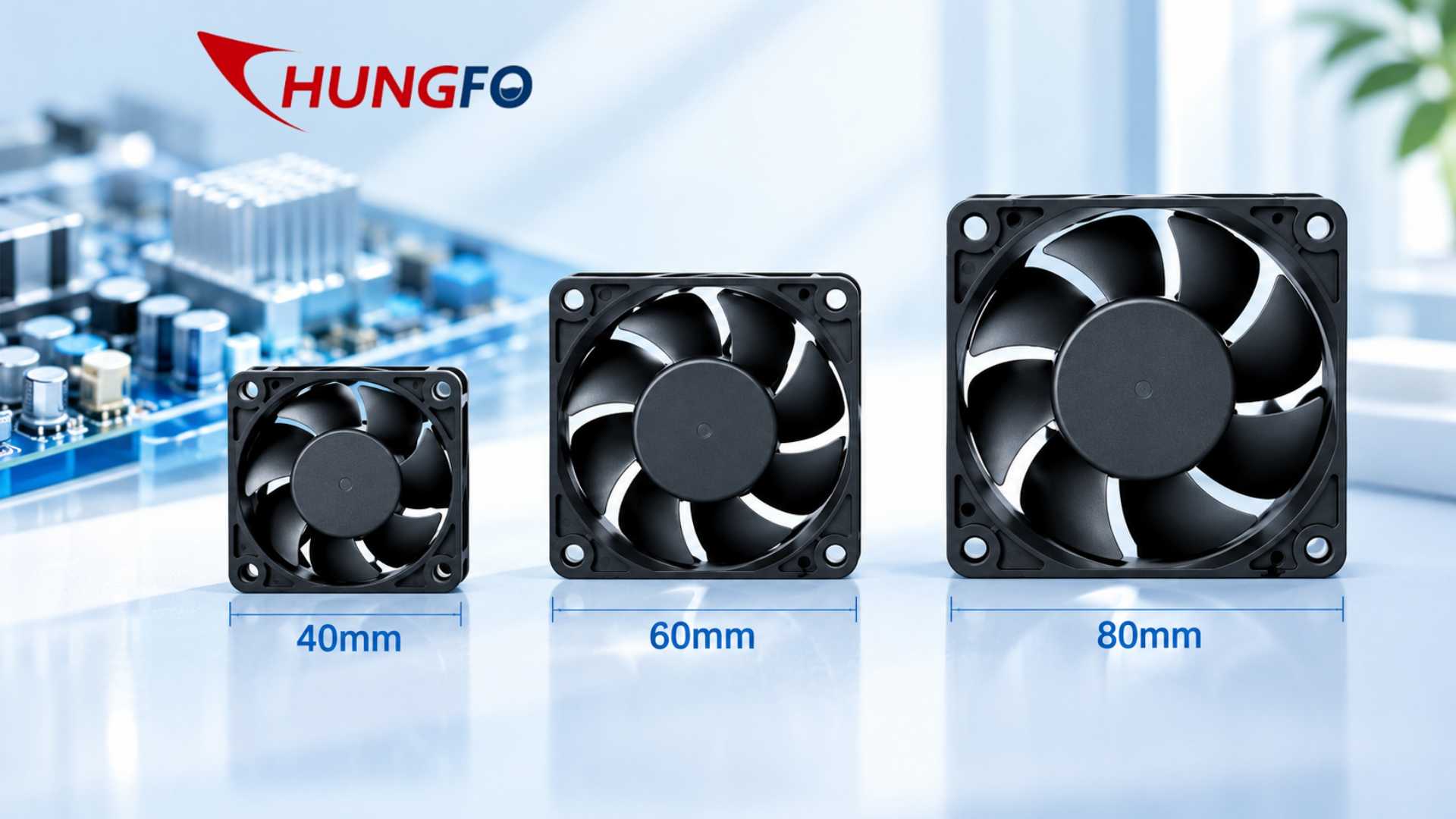
Among the commonly used compact cooling solutions, 40mm, 60mm, and 80mm axial fans are important choices for electronic equipment manufacturers. Although these fans share a similar operating principle, their dimensions, airflow characteristics, installation requirements, and suitable applications can differ considerably.
A 40mm fan is generally considered for compact devices where installation space is restricted. A 60mm fan provides a middle-ground solution for equipment requiring more airflow without occupying excessive space. An 80mm fan offers a larger airflow area and can support cooling requirements in relatively spacious electronic enclosures.
Nevertheless, physical dimensions alone cannot determine cooling performance. Two fans with identical frame sizes may have significantly different airflow, static pressure, rotational speed, power consumption, and acoustic characteristics. Engineers and purchasing professionals should therefore evaluate the complete technical specifications before making a selection.
This guide explains the differences between 40mm, 60mm, and 80mm cooling fans, examines their applications, and provides practical advice for selecting suitable DC cooling fans. It also explains how fan construction, motor technology, bearing systems, and manufacturing quality influence long-term performance.
2. Understanding 40mm, 60mm, and 80mm Fan Dimensions
Before comparing different cooling fan sizes, it is important to understand how fan dimensions are measured. A standard square axial fan is generally described by three measurements: frame length, frame width, and frame thickness. For example, a 40mm × 40mm × 10mm fan has a square frame measuring 40mm on each side and a thickness of 10mm.
The first two dimensions determine the installation footprint, while the third dimension determines how much depth the fan occupies inside the equipment. This distinction is important because electronic products often have limited internal clearance.
A 40mm fan typically has a frame measuring 40mm × 40mm. Depending on the product series, its thickness may include 10mm, 15mm, or other customized dimensions. These compact products are frequently integrated into small electronic housings, miniature instruments, and localized cooling assemblies.
A 60mm fan normally has a 60mm × 60mm frame. Its thickness can vary according to the required airflow and installation design. Compared with a 40mm model, it provides a larger fan blade area and may offer greater airflow capacity when designed for comparable operating conditions.
An 80mm fan generally measures 80mm × 80mm. Its larger frame provides more room for blade design and airflow movement. Depending on its thickness, motor, and rotational speed, it can support a wider range of equipment cooling requirements.
When comparing fan dimensions, buyers should also examine mounting-hole spacing, screw diameter, connector position, cable length, and frame tolerance. A fan that matches the external dimensions may still be incompatible with the original mounting structure.
For replacement projects, measuring the original fan and checking its technical drawing are particularly important. For new product development, engineers should reserve sufficient installation clearance for the fan frame, cable routing, protective grille, and surrounding components.
3. 40mm Fans: Compact Cooling for Space-Limited Electronics
40mm cooling fans are commonly selected for electronic products where available installation space is extremely limited. Their compact dimensions allow equipment designers to introduce forced-air cooling without significantly increasing the overall size of the product.
Typical applications include small power supplies, network modules, embedded computing devices, communication equipment, miniature industrial controllers, charging equipment, and compact household appliances.
One of the main advantages of a 40mm fan is its flexibility in small mechanical structures. It can be positioned near a specific heat-generating component, making it suitable for localized cooling. For example, a small fan may direct airflow toward a power semiconductor, voltage regulator, transformer, or heat sink.
However, the limited blade diameter means that a 40mm fan may need a relatively high rotational speed to achieve the required airflow. Higher rotational speed can increase operating noise, vibration, and motor loading. Engineers should therefore evaluate the relationship between airflow, static pressure, and acoustic performance rather than selecting a fan based only on its maximum RPM.
The thickness of a 40mm fan is another important consideration. A thin 40mm × 40mm × 10mm model can fit into narrow spaces, while a thicker design may provide additional room for blade geometry and motor components. The final performance depends on the complete fan design rather than thickness alone.
For products requiring a small cooling assembly, a small DC motor fan can provide a convenient solution because its motor and fan structure can be integrated into a compact electrical system. Depending on the project, buyers can select different voltage levels, bearing structures, speed grades, and electrical connections.
A small fan is not automatically suitable for every compact electronic product. If the enclosure contains several heat sources or has a complicated airflow path, a single 40mm fan may not provide sufficient cooling. In these situations, engineers should consider multiple fans, improved ventilation openings, or a centrifugal blower.
The important selection principle is to match the fan's actual operating performance with the thermal requirements of the equipment.
4. 60mm Fans: Balancing Airflow and Installation Space
60mm cooling fans provide an intermediate solution between compact 40mm models and larger 80mm products. Their dimensions make them suitable for electronic equipment that requires more airflow capacity but cannot accommodate a larger fan.
Common applications include routers, networking devices, communication cabinets, compact industrial equipment, electronic control boxes, power modules, and small server-related assemblies.
The larger frame provides additional blade area compared with a 40mm fan. This can help manufacturers develop fan models with different airflow and pressure characteristics. Depending on the blade geometry, motor design, and frame thickness, a 60mm fan can support cooling requirements that would be difficult to satisfy with a smaller model.
Another advantage is its adaptability to different equipment layouts. A 60mm fan can be installed as an intake or exhaust component, depending on the thermal design. In a compact enclosure, it can help establish a more organized airflow path by moving air across circuit boards and heat-generating components.
However, buyers should not assume that every 60mm fan provides better cooling than every 40mm model. A high-speed 40mm fan with a suitable pressure characteristic may perform better than a low-speed 60mm fan in a restrictive airflow channel. Performance must be evaluated using the actual airflow and pressure data.
The 60mm category also offers opportunities for customized fan development. Manufacturers may adjust blade profiles, motor specifications, bearing structures, electrical protection functions, and cable configurations according to customer requirements.
For OEM projects, these customization options are valuable because the fan must work with the entire equipment system rather than operate as an independent component.
When selecting a 60mm fan, engineers should confirm its rated voltage, operating current, rotational speed, airflow, static pressure, noise level, and expected service life. Installation drawings and sample testing should also be included in the evaluation process.
5. 80mm Fans: Higher Airflow for Larger Electronic Enclosures
80mm cooling fans are widely used in electronic equipment with more available installation space and relatively demanding ventilation requirements. Their larger frame allows manufacturers to design broader blade structures and different motor configurations.
Typical applications include desktop electronic equipment, industrial control cabinets, larger power supplies, communication systems, automation equipment, and equipment enclosures containing multiple heat-generating components.
Compared with smaller fan sizes, an 80mm fan can often provide higher airflow at a relatively lower rotational speed when the designs are appropriately matched. This characteristic can be useful in applications where noise reduction is important.
For example, a desktop device operating near users may require sufficient cooling while maintaining an acceptable acoustic environment. A properly selected 80mm fan may help achieve this balance without requiring the same rotational speed as a smaller fan.
Another advantage is its ability to distribute airflow across a wider area. Rather than concentrating airflow on a single small location, an 80mm fan can help circulate air through a larger enclosure. This is particularly useful when several components generate heat simultaneously.
Nevertheless, a larger fan does not automatically guarantee lower noise or better cooling. Blade design, motor quality, bearing selection, installation conditions, grille resistance, and operating speed all affect actual performance.
An 80mm fan also requires more mounting space and mechanical clearance. Designers must ensure that the surrounding components do not block the intake or exhaust area. Poorly designed ventilation openings can reduce the benefits of a larger fan.
For equipment with high internal airflow resistance, engineers should also consider whether an axial fan is appropriate. A centrifugal blower may be more suitable when air must travel through narrow ducts, filters, or complex internal channels.
The final choice should be based on measured performance under actual installation conditions.
6. 40mm vs. 60mm vs. 80mm Fan Comparison
The three fan sizes serve different engineering requirements. Their differences are not limited to external dimensions. They also influence the available blade area, installation footprint, potential airflow capacity, noise characteristics, and equipment integration.
A 40mm fan is generally appropriate when compact dimensions are the primary consideration. It is useful for localized cooling, small electronic modules, and products with limited internal clearance.
A 60mm fan offers a balance between size and airflow capability. It can be considered when the cooling requirements exceed the capacity of a small fan but the equipment cannot accommodate an 80mm frame.
An 80mm fan is more appropriate when the enclosure provides sufficient space and requires ventilation across a relatively large area. It can also provide design flexibility for applications prioritizing airflow and noise management.
These descriptions are general design references, not guaranteed performance specifications. Actual airflow and noise values must be obtained from the manufacturer's technical datasheet.
When comparing products, buyers should also consider fan thickness. An 80mm × 80mm × 15mm fan may have different performance characteristics from an 80mm × 80mm × 25mm model, even though both belong to the same frame-size category.
7. How Fan Size Affects Airflow and Static Pressure
Airflow and static pressure are two essential specifications in cooling fan selection. Understanding their differences helps engineers avoid choosing a fan that looks suitable on paper but performs poorly after installation.
Airflow describes the volume of air a fan can move over a specific period. Common measurement units include CFM and cubic meters per hour. Higher airflow can help remove more heat when the air reaches the components that require cooling.
Static pressure describes the fan's ability to overcome resistance in an airflow system. Resistance may come from protective grilles, dust filters, heat sink fins, narrow openings, internal ducts, and densely arranged components.
A fan with high free-air airflow may not maintain the same airflow after installation. When resistance increases, the operating airflow changes according to the fan performance curve and the system resistance curve.
This is why engineers should examine the fan's pressure-flow performance rather than relying exclusively on maximum airflow specifications.
A larger frame can provide more opportunities for airflow improvement, but the relationship is not a simple linear calculation. Blade shape, blade count, hub diameter, motor speed, and frame geometry all influence performance.
For example, a 40mm fan designed for high static pressure may be suitable for directing air through a compact heat sink. Meanwhile, an 80mm fan with a higher free-air airflow value may be more appropriate for ventilating a relatively open equipment enclosure.
The correct selection depends on the resistance of the complete airflow path.
For projects involving filters, narrow channels, or complicated internal structures, engineers should evaluate whether a centrifugal blower would provide a more suitable airflow direction and pressure characteristic than a conventional axial fan.
8. How to Choose the Right Fan Size for Different Applications
The best way to select a cooling fan is to begin with the thermal and mechanical requirements of the equipment. Choosing a fan based only on its external dimensions can lead to insufficient cooling or unnecessary energy consumption.
First, identify the heat-generating components. Determine their power consumption, expected heat dissipation, operating temperature limits, and working environment. Equipment with multiple high-power components may require a different ventilation arrangement from a device containing only one localized heat source.
Second, evaluate the available installation space. Measure the mounting area, frame depth, screw-hole spacing, cable routing area, and clearance around the fan. These measurements help determine whether a 40mm, 60mm, or 80mm fan can be installed without interfering with other components.
Third, estimate the required airflow. The heat load and acceptable temperature rise provide a starting point for thermal calculations. However, actual cooling requirements also depend on air distribution, enclosure leakage, heat transfer, and environmental conditions.
Fourth, consider the airflow path. If the equipment has an open ventilation structure, an axial fan may be suitable. If the air must pass through a narrow duct or dense heat sink, a fan with an appropriate static-pressure characteristic or a centrifugal blower may be necessary.
Fifth, evaluate noise and power consumption. A fan that meets airflow requirements but generates excessive noise may not be acceptable for consumer electronics or office equipment. Similarly, a fan with excessive current consumption may not suit a battery-powered or energy-sensitive device.
Finally, conduct sample testing. Install the candidate fan in the actual equipment and measure temperatures at critical locations under representative operating conditions. Testing should include normal operation, high-load conditions, and expected environmental temperatures.
The final fan selection should provide sufficient thermal margin without creating unnecessary mechanical, electrical, or acoustic problems.
9. Important Specifications Beyond Fan Dimensions
Frame dimensions are only one part of a cooling fan's technical profile. Buyers should evaluate several other specifications before placing an order.
Rated voltage is particularly important. Common DC cooling fan options include 5V, 12V, and 24V, although other voltage configurations are also available. The selected fan must be compatible with the equipment's power supply and electrical control system.
Rated current determines the electrical load required by the fan. Engineers should verify that the power supply and control circuit can support the fan's starting and operating current.
Rotational speed, generally expressed in RPM, describes how quickly the fan blades rotate. However, RPM alone cannot determine airflow or cooling effectiveness because blade geometry and pressure characteristics also play important roles.
Airflow and static pressure should be evaluated together. A fan may deliver high airflow in an unrestricted environment but perform differently when installed behind a filter or inside a compact enclosure.
Noise level is another important specification. Manufacturers generally provide acoustic values in decibels, although measurement distance, testing environment, and equipment configuration can influence the results. Buyers should compare products under consistent test conditions.
Bearing type also affects operating characteristics and expected service life. Sleeve bearings are commonly used in cost-sensitive applications, while ball bearings may be considered for demanding operating conditions and different mounting orientations.
Other useful specifications include operating temperature range, insulation characteristics, motor protection, locked-rotor protection, polarity protection, waterproof rating, connector type, and cable length.
A complete technical comparison helps buyers avoid selecting a fan that matches the mechanical dimensions but fails to satisfy the electrical or thermal requirements.
10. DC Fan Voltage, Motor Design, and Bearing Selection
DC cooling fans are widely used in electronics because they can be integrated into low-voltage power systems and controlled according to equipment requirements.
A 5V DC fan may be suitable for compact electronic devices, embedded systems, and products powered by low-voltage circuits. A 12V DC fan is commonly considered for communication equipment, industrial electronics, and various consumer products. A 24V DC fan may be appropriate for industrial control systems and equipment using a 24V power architecture.
The voltage should always match the fan's rated specification. Applying an unsuitable voltage can cause unstable operation, overheating, reduced service life, or motor damage.
Motor design influences rotational speed, electrical efficiency, torque, and operating stability. Brushless DC motors are commonly used in modern cooling fans because they eliminate the mechanical brushes found in traditional brushed motors.
A properly designed brushless motor can provide stable operation and support additional functions such as speed feedback, automatic restart, and PWM speed control. The availability of these features depends on the fan model and electrical configuration.
Bearing selection should be based on the operating environment and expected working hours. Sleeve bearings can be suitable for applications with moderate operating requirements and cost constraints. Ball bearings are often considered when higher operating reliability, longer working periods, or different mounting orientations are required.
However, bearing type alone does not guarantee service life. Lubrication quality, operating temperature, vibration, dust exposure, motor design, and manufacturing consistency also influence the overall reliability of a cooling fan.
For OEM customers, it is important to discuss the complete electrical and mechanical requirements with the manufacturer before confirming a customized specification.
11. Installation, Airflow Direction, and Noise Considerations
Correct installation is essential for achieving the expected performance of a cooling fan. Even a technically suitable product may provide inadequate cooling if its airflow direction or mounting position is incorrect.
Most axial cooling fans have a defined airflow direction and blade rotation direction. These are commonly indicated by arrows on the fan frame. Engineers should confirm the required intake or exhaust direction before installation.
An intake fan introduces cooler external air into the equipment. An exhaust fan removes heated internal air. Depending on the enclosure design, a combination of both can establish a more effective ventilation arrangement.
The placement of ventilation openings also matters. If the intake and exhaust openings are too close, air may circulate directly between them without adequately cooling the internal components. This condition can reduce cooling efficiency.
Protective grilles and filters can improve equipment safety and reduce dust accumulation, but they also increase airflow resistance. The fan must have sufficient pressure capability to operate under these conditions.
Noise is influenced by several factors, including rotational speed, blade geometry, bearing condition, motor vibration, airflow turbulence, and mechanical resonance. A fan mounted directly against a thin metal panel may transmit vibration into the enclosure.
Rubber mounting elements, suitable structural reinforcement, and optimized operating speed can help reduce unwanted noise and vibration.
Regular inspection is also recommended for equipment operating in dusty or high-temperature environments. Dust accumulation can restrict airflow, increase operating temperature, and affect the long-term condition of the fan.
12. How to Evaluate a Cooling Fan Manufacturer
Selecting the correct fan size is only one part of a successful cooling project. The manufacturing supplier also plays an important role in product consistency, technical support, customization, and long-term supply stability.
B2B buyers should first examine the manufacturer's product range. A supplier offering 40mm, 60mm, and 80mm cooling fans, as well as different voltage, thickness, and bearing configurations, may provide more flexibility for different equipment projects.
Second, evaluate the manufacturer's technical capabilities. Important factors include motor development, blade design, mold development, airflow testing, noise measurement, dynamic balancing, and product reliability verification.
Third, examine quality management. Production inspection, incoming material control, process monitoring, and outgoing quality control help maintain product consistency between batches.
Fourth, check whether the manufacturer can support OEM and ODM requirements. Customized cable lengths, connectors, electrical functions, labels, mounting structures, and performance specifications may be necessary for specialized equipment.
Fifth, review relevant product certifications and compliance documents. Requirements depend on the destination market and final equipment application. Buyers should verify that the certificates and reports apply to the actual product model and intended use.
China Chungfo Fan focuses on the research, development, manufacturing, and sales of DC and AC cooling fans, blowers, cross-flow fans, and motors. With manufacturing capabilities covering product development, mold processing, injection molding, SMT, assembly, and quality inspection, the company supports customers requiring customized cooling solutions.
Its manufacturing and testing capabilities include dynamic balancing equipment, wind-tunnel and pressure testing equipment, noise testing facilities, high- and low-temperature chambers, salt-spray testing equipment, and electrical inspection instruments.
For customers selecting compact cooling fans, cooperation with a manufacturer that understands both product construction and application requirements can help reduce compatibility risks and improve project development efficiency.
13. Common Mistakes When Selecting Electronics Cooling Fans
One common mistake is selecting a fan based only on its frame dimensions. A 40mm fan, 60mm fan, or 80mm fan may fit the mounting area, but its actual airflow and static pressure may not meet the thermal requirements.
Another mistake is comparing maximum airflow values without considering installation resistance. Free-air airflow measurements do not represent the actual operating airflow inside an equipment enclosure.
Some buyers also overlook fan thickness and mounting-hole spacing. Even when the frame length and width match, different thicknesses or mounting patterns may prevent installation.
Electrical compatibility is equally important. Selecting the wrong voltage or overlooking starting current can create problems for the equipment's power supply and control circuit.
Noise requirements are sometimes considered too late in product development. A fan that produces acceptable cooling performance may still be unsuitable for a noise-sensitive application.
Another issue is ignoring the operating environment. High temperature, dust, moisture, vibration, and continuous operation can influence bearing life and overall reliability.
Finally, buyers should avoid choosing products based only on the lowest purchase price. A lower initial cost does not necessarily mean a lower total operating cost. Product consistency, service life, energy consumption, replacement frequency, and technical support should all be considered.
A complete selection process should combine mechanical verification, electrical evaluation, airflow analysis, and sample testing.
14. Frequently Asked Questions
14.1 What Is the Difference Between a 40mm, 60mm, and 80mm Cooling Fan?
The primary difference is their external frame size and the design opportunities available for airflow. A 40mm fan is suitable for compact electronic products, a 60mm fan provides an intermediate solution, and an 80mm fan can support ventilation in larger equipment enclosures. Actual cooling performance depends on the complete technical specifications.
14.2 Does a Larger Cooling Fan Always Provide More Airflow?
No. A larger fan generally offers more potential blade area, but airflow depends on rotational speed, blade geometry, motor design, and system resistance. A smaller high-speed fan may outperform a larger low-speed model under certain operating conditions.
14.3 Which Fan Size Is Suitable for Small Electronic Devices?
A 40mm fan is often considered for devices with limited installation space. However, the correct choice depends on the heat load, internal airflow path, and required temperature rise. Some compact products may benefit from a small centrifugal blower instead of an axial fan.
14.4 Is a 60mm Fan Better Than a 40mm Fan?
Neither size is universally better. A 60mm fan may provide additional airflow capacity, but it also requires more installation space. A 40mm model may be more suitable when the equipment has strict dimensional limitations.
14.5 When Should I Choose an 80mm Fan?
An 80mm fan can be considered when the enclosure has sufficient mounting space and requires ventilation across a relatively large area. It is commonly evaluated for industrial controllers, desktop electronics, power supplies, and larger equipment housings.
14.6 What Voltage Should I Choose for a DC Cooling Fan?
The voltage should match the equipment's power supply. Common options include 5V, 12V, and 24V DC. Buyers should also verify rated current, startup characteristics, and control compatibility.
14.7 How Can I Compare Small DC Fan Price Between Manufacturers?
When comparing small DC fan price, buyers should consider more than the quoted unit cost. Specifications, bearing type, motor quality, certifications, customization, order quantity, packaging, and expected service life can all influence the total purchasing cost.
14.8 Can a Cooling Fan Be Customized for OEM Equipment?
Yes. Depending on the manufacturer's capabilities, customization may include voltage, current, rotational speed, airflow, connectors, cable length, bearing type, frame dimensions, and special protection functions. Technical requirements should be confirmed before sample production.
14.9 What Is the Difference Between an Axial Fan and a DC Blower?
An axial fan generally moves air along the axis of its rotating blades and is widely used for enclosure ventilation. A centrifugal blower draws air into its inlet and directs it through an outlet, making it useful for applications that require a more directed airflow path or higher pressure capability.
14.10 How Can I Improve Cooling Performance Without Increasing Fan Size?
Engineers can optimize ventilation openings, reduce unnecessary airflow resistance, improve heat sink design, reposition the fan, and optimize internal airflow channels. Selecting a fan with a more suitable pressure-flow characteristic may also improve cooling without changing the frame size.
15. Conclusion: Selecting the Right Fan for Reliable Electronics Cooling
The choice between 40mm, 60mm, and 80mm cooling fans should be based on the equipment's thermal requirements, installation space, airflow resistance, electrical design, and operating environment.
A 40mm fan provides a compact solution for small electronic devices and localized cooling. A 60mm fan offers a balance between installation space and airflow capability. An 80mm fan provides greater design flexibility for larger enclosures and broader ventilation requirements.
However, frame size should never be treated as the only selection criterion. Airflow, static pressure, rotational speed, noise, voltage, bearing type, and product reliability must all be evaluated together.
For equipment manufacturers and B2B purchasing teams, working with an experienced cooling fan supplier can simplify technical evaluation and product customization. By combining accurate specifications, sample testing, and application-based engineering, companies can develop more reliable thermal management systems.
China Chungfo Fan provides DC and AC cooling fans, blowers, cross-flow fans, and customized motor solutions for different electronic and industrial applications. Whether your project requires a compact 40mm fan, a balanced 60mm solution, or an 80mm ventilation fan, selecting the right product starts with understanding the actual cooling requirements of your equipment.