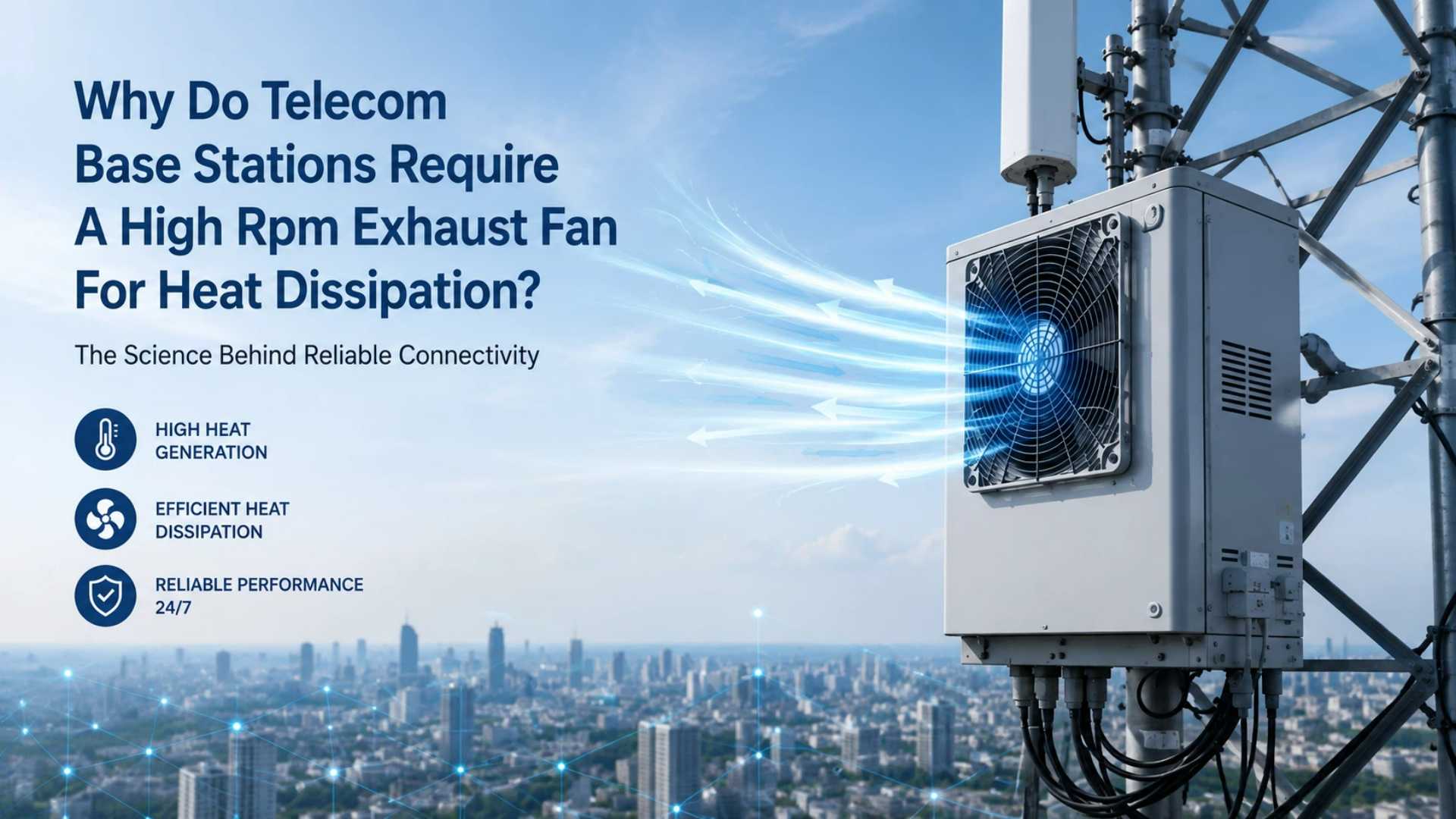
通信基地局に放熱用の高回転排気ファンが必要な理由は何ですか?
August 26 , 2026通信基地局は、現代の無線通信ネットワークの基盤となるものです。4Gマクロ基地局や5Gスモールセルから、屋外通信キャビネット、無線ユニット、ベースバンド機器、エッジ通信システムに至るまで、これらの設備は厳しい環境条件下で継続的に稼働する必要があります。一般的な電子機器とは異なり、通信基地局は24時間体制での稼働が求められ、多くの場合、保守が困難で周囲温度が大きく変化する場所に設置されます。
通信技術の高速化と機器の小型化に伴い、熱管理は基地局設計においてますます重要な要素となっています。処理能力の向上、伝送容量の増加、機器密度の増加は、通信キャビネット内部の発熱量を大幅に増加させる可能性があります。この熱を効率的に除去できない場合、内部温度が上昇し、サーマルスロットリング、性能低下、部品の劣化、アラーム発生、さらには予期せぬシャットダウンを引き起こす可能性があります。
高回転数排気ファンが通信基地局の冷却システムによく採用される主な理由の一つは、まさにこの点にあります。高速ファンは、狭い設置スペースでも強力な気流を生み出し、放熱性を向上させ、重要な電子部品周辺の温度を安定に保つのに役立ちます。しかし、回転数だけではファンの適合性は決まりません。気流、静圧、ファンの形状、動作電圧、信頼性、環境保護、制御機能など、すべてを総合的に考慮する必要があります。
通信機器メーカーやシステムインテグレーターにとって、基地局用の冷却ファンを選定する際には、ファンの回転速度と熱性能の関係を理解することが不可欠です。
通信基地局はなぜそんなに多くの熱を発生するのか?
通信基地局内のほぼすべての電子機器は電力を消費し、その電力の大部分は最終的に熱に変換されます。無線周波数機器、ベースバンド処理ユニット、電源装置、光モジュール、スイッチ、ルーター、その他の電子部品はすべて、総熱負荷に寄与する可能性があります。
5Gインフラにおいては、状況はさらに複雑化する。なぜなら、最新の通信機器は、より大量のデータをより低い遅延で処理するように設計されているからだ。処理性能の向上は消費電力の増加につながり、機器の小型化は限られた筐体内の熱密度を高める可能性がある。
問題は単に熱の総量だけではありません。熱分布も重要です。筐体全体の平均温度は許容範囲内でも、個々の部品は局所的に非常に高い温度になることがあります。こうした局所的な高温箇所は、パワー半導体、プロセッサ、通信モジュール、その他の温度に敏感な部品にとって特に危険です。
通信基地局の冷却に関する研究では、気流の配置が重要であることが明らかになっている。気流の分布が不適切だと、局所的な高温箇所が発生し、通信機器の温度が上昇する可能性があるためだ。ある実地調査では、空気の分布を改善することが、機器の温度を維持し、冷却エネルギー消費量を削減する上で重要な要素であることが確認された。
そのため、適切に設計された排気ファンは、単に空気を移動させるだけではいけません。キャビネット内部に予測可能な空気の流れ経路を確立するのに役立つものでなければなりません。
高回転排気ファンは実際にはどのような働きをするのでしょうか?
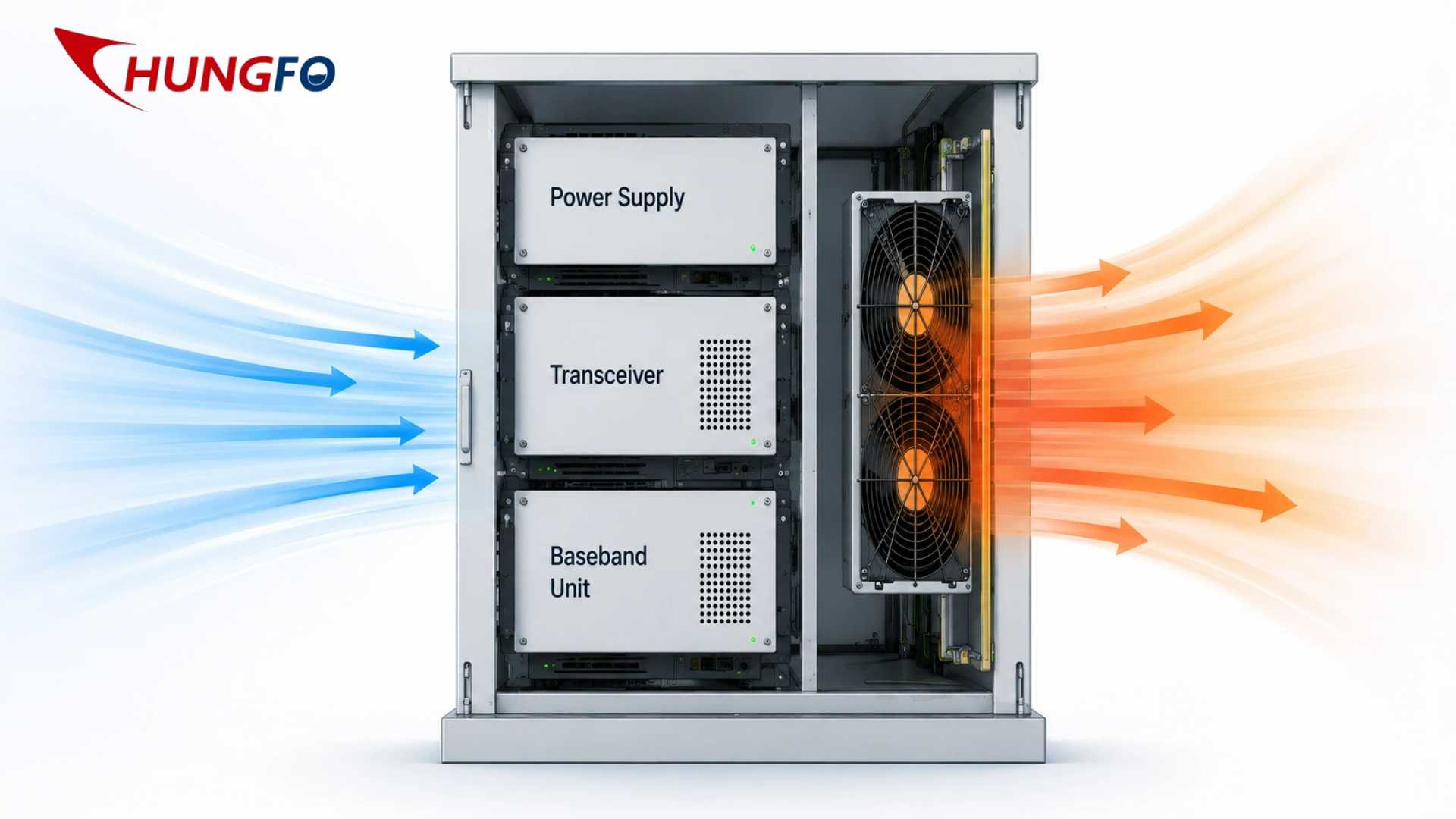
排気ファンの主な目的は、筐体内の熱気を排出し、指定された開口部から冷たい空気を流入させることです。これにより、継続的な強制対流が発生し、電子部品の周囲に熱がこもるのを防ぎます。
RPMとは、1分あたりの回転数を意味します。一般的に、ファンの回転速度を上げると、風量と圧力能力が向上しますが、その正確な関係はファンの設計によって異なります。回転数の高いファンは、狭い空間でもより多くの空気を移動させることができ、特に筐体内にフィルター、グリル、ヒートシンク、ダクト、その他の空気の流れを妨げる部品がある場合に有効です。
例えば、低速ファンは自由空間で動作しているときは十分な風量を確保できるかもしれませんが、保護グリルやフィルターの後ろに設置すると性能が大幅に低下する可能性があります。より高速な設計であれば、こうした実際の動作条件下で有効な風量を維持するために必要な追加の圧力能力を提供できるでしょう。
そのため、エンジニアは自由空気流量の定格値のみに基づいてファンを選定することを避けるべきです。静圧がゼロの状態で高い風量を提供するファンでも、実際の通信機器キャビネット内に設置した場合、必ずしも十分な冷却性能を発揮するとは限りません。
空気の流れと抵抗の関係は、ファンを選定する上で最も重要な概念の一つです。
通信機器の冷却において静圧が重要な理由とは?
静圧とは、ファンが空気の流れ経路内の抵抗を克服する能力を表すものです。通信機器のキャビネット内では、空気の流れが完全に開放された環境を通過することはほとんどありません。
空気は、キャビネットから出るまでに、吸気グリル、ダストフィルター、ヒートシンク、電子モジュール、保護メッシュ、狭い通路、排気口などを通過する必要がある。これらの部品のそれぞれが圧力損失を引き起こす可能性がある。
圧力抵抗が増加すると、ファンの実際の風量は減少します。したがって、自由空気流量が大きいファンでも、十分な圧力を発生できない場合は、実際の密閉空間では性能が低下する可能性があります。
これは高回転排気ファン回転速度が高いほど、システム抵抗が大きくなってもファンが有効なエアフローを維持できるため、有利になる場合があります。ただし、エンジニアはファンの最大回転数や最大エアフロー値だけに頼るのではなく、常にファンの性能曲線を評価する必要があります。
優れた通信機器用冷却設計は、システム全体の空気流量要件の把握から始まります。設計者は、熱負荷を推定し、許容温度上昇を決定し、空気抵抗を特定した上で、必要なシステム動作点で効率的に動作できるファンを選択する必要があります。
小型通信機器用キャビネットにおいて、高回転数(RPM)が有用な理由とは?
現代の通信機器における大きな制約の一つは、設置スペースの制約です。通信機器は小型化が進む一方で、処理能力は向上し続けています。これは、エンジニアがより小さな体積からより多くの熱を除去する必要があることを意味します。
大型ファンは低回転数でより多くの空気を送風できる可能性があるが、設置スペースが限られている場合がある。設置場所が限られている場合は、小型で高回転数のファンが実用的な代替手段となる。
これは特に、小型通信機器、無線機器、ネットワーク機器、コンパクトな屋外筐体などに当てはまります。これらの用途では、ファンの回転速度を上げることで、冷却システムの物理的な寸法を大幅に大きくすることなく、必要な熱性能を達成できます。
しかしながら、高回転数を万能の解決策と考えるべきではありません。回転数を上げると、騒音、振動、ベアリングへの負荷、消費電力も増加する可能性があります。正しい目標は、可能な限り高い回転数を達成することではなく、必要な風量と圧力を、可能な限り低いエネルギーと騒音コストで実現することです。
通信機器におけるDC冷却ファンの役割
A冷却ファン DC通信機器の設計において、DC冷却ファンは魅力的な選択肢となることが多い。なぜなら、多くの通信システムはすでにDC電源アーキテクチャを採用しているからである。通信インフラは一般的に専用のDC電源システムで運用されているため、DC冷却ファンを直接組み込むのに都合が良い。
DCファンは、速度制御、監視、およびシステムレベルの熱管理にも対応できます。設計によっては、制御信号を使用してファン速度を監視したり、異常な動作状態を検出したりすることができます。
遠隔地の通信設備においては、この機能は非常に貴重です。基地局は、農村部、屋上、幹線道路沿いなど、頻繁な手動点検が困難な場所に設置されている場合があります。冷却ファンが予告なく故障した場合、温度上昇によって通信機器に影響が出る可能性があります。
そのため、現代の通信機器用冷却システムでは、速度フィードバック、故障警報、その他の監視機能を提供するファンがしばしば利用される。
DCブラシレス軸流ファンが広く使用されている理由とは?
DCブラシレス軸流ファンコンパクトなサイズ、直接的な気流、効率的な電子整流を兼ね備えているため、多くの通信機器の冷却用途に最適です。
従来のブラシ付きモーターとは異なり、ブラシレスモーターは整流に機械式ブラシを使用しません。これにより、主要な機械的摩耗の原因が排除され、長時間の連続運転を必要とする用途に適した技術となっています。
軸流ファンは、一般的にファンシャフトと平行に空気を移動させます。そのため、キャビネットや換気ダクトを通して大量の空気を移動させる場合に特に効果的です。
通信機器も、ブラシレスDCモーターの制御性の高さから恩恵を受ける。ファン速度は温度や機器負荷に応じて調整可能だ。熱負荷が低い時期には、ファンを低速で運転できる。内部温度が上昇すると、コントローラーがファン速度を上げて冷却能力を向上させる。
この手法は、熱安全性を維持しながら、不要な電力消費と騒音を削減できる。
高回転数だからといって、ファンが常に最大速度で回転しなければならないわけではありません。適切に設計された制御システムであれば、必要な時に高速回転を可能にし、通常の状態では低速回転で動作させることができます。
通信機器キャビネット用軸流ファンブロワーの選定
強制換気ソリューションについて議論する際、軸流ファンブロワーという用語は広義に用いられることがあるが、製品を選定する際には、エンジニアは軸流式と遠心式の気流特性を区別する必要がある。
軸流ファンは、大量の空気を比較的直線的な気流経路で送る必要がある場合に一般的に好まれます。一方、遠心送風機は、より高い圧力が必要で、気流がダクトや狭い通路を通過する必要がある場合に適しています。
通信機器用キャビネットの場合、適切な選択は筐体構造、耐圧性、冷却方式によって決まります。
キャビネットに大きな通気口があり、空気の流れ経路が比較的広い場合は、軸流ファンが効率的な解決策となる可能性があります。空気が密度の高い熱交換器、狭い通路、または複雑なダクトシステムを通過する必要がある場合は、より高圧のファンまたはブロワーの方が適しているかもしれません。
この区別は重要です。なぜなら、ファンタイプを間違えると、定格風量が十分であっても、冷却性能が期待外れになる可能性があるからです。
高回転数と放熱効率
筐体からの放熱は、熱負荷、空気の流れ、温度上昇の間の基本的な関係によって説明できる。
システムが一定量の熱を発生させる場合、流入する空気が内部の空気よりも十分に低温であれば、筐体を通過する空気の量を増やすことで、一般的に入口空気と出口空気の温度上昇を抑えることができる。
これは、高い熱負荷に対応するために追加の空気流量が必要な場合、高回転数が有効であることを意味する。
However, thermal performance depends on more than airflow quantity. The location of the inlet, the position of heat-generating components, the direction of fan rotation, the exhaust location and the internal structure of the cabinet all affect the actual cooling result.
If the fan creates airflow that bypasses the hottest components, the theoretical airflow rating may not translate into effective component cooling.
This is why airflow organization is as important as fan performance.
The Importance Of Airflow Direction
A successful telecom cooling system should establish a clear airflow path.
Cool air should enter from an appropriate location, pass across the heat-generating components and then leave the cabinet through an exhaust path. The airflow should not circulate unnecessarily inside the enclosure.
An exhaust fan mounted at the correct position can create negative pressure inside the cabinet and encourage air to move through the intended path.
For example, if hot air naturally accumulates near the upper part of the cabinet, an exhaust fan installed near the upper outlet can help remove that accumulated heat. At the same time, an intake opening should be positioned to provide cooler air to the equipment.
The exact configuration depends on cabinet geometry and component arrangement.
Why 5G Makes Cooling More Challenging
5G communication equipment introduces additional thermal management challenges because the infrastructure is designed for high data throughput, low latency and dense deployment.
Research has shown that increasing power density and energy consumption in 5G base stations make thermal performance and energy efficiency increasingly important. Hybrid cooling systems and cabinet-level thermal management have therefore become active areas of engineering research.
In practical applications, the cooling system must work continuously while maintaining equipment temperature under changing outdoor conditions.
An outdoor cabinet can experience high solar radiation, high ambient temperature, humidity, rain, dust and salt exposure. These factors place additional demands on the fan.
A fan that performs well in a laboratory may not necessarily provide the same reliability in a coastal outdoor cabinet.
Environmental Requirements For Telecom Exhaust Fans
Outdoor telecom equipment may operate under a wide range of environmental conditions. Temperature, humidity, dust, water, salt spray and vibration can all affect fan performance.
For outdoor applications, designers should therefore consider the appropriate protection structure, corrosion resistance, bearing technology and material selection.
The fan housing and impeller must maintain mechanical integrity under temperature changes. Bearings must be capable of supporting long continuous operation. Electronic components should be designed for the expected voltage and temperature range.
In coastal environments, salt and moisture can accelerate corrosion. In dusty environments, filters may become blocked and increase airflow resistance. This can cause the fan operating point to move toward a lower airflow condition.
A reliable telecom cooling system should therefore consider the fan and the entire ventilation system as one integrated design.
Fan Reliability Is As Important As Fan Speed
Telecom infrastructure is often expected to operate continuously for years. A fan that delivers excellent airflow but fails prematurely is not a reliable cooling solution.
Bearing selection is one important factor. Ball bearings are commonly considered for applications requiring long service life and wide operating conditions, while sleeve bearing designs may be suitable for certain cost-sensitive or controlled environments.
Motor quality, winding design, electronic commutation, impeller balance and manufacturing consistency also affect service life.
Dynamic balancing is particularly important for high RPM fans. As rotational speed increases, imbalance can create greater vibration and mechanical stress. A properly balanced impeller helps reduce vibration and improves overall operating stability.
This is why high RPM fan manufacturing requires careful control of mechanical tolerances and production quality.
Noise And High RPM
One disadvantage of high RPM operation is increased noise.
Telecom equipment may be installed near offices, residential areas, transportation infrastructure or other locations where acoustic performance matters. A fan running continuously at maximum speed can generate unnecessary noise if the thermal load is actually low.
The solution is not necessarily to avoid high RPM fans. Instead, the system can use intelligent speed control.
Temperature sensors can monitor the internal environment and adjust fan speed according to thermal demand. When the cabinet is cool, the fan can operate at a lower speed. When temperature increases, the controller can increase RPM.
This provides a balance between cooling capacity, energy consumption and noise.
Energy Efficiency In Base Station Cooling
Cooling can represent a significant part of the overall energy consumption of communication infrastructure. Therefore, thermal management must balance reliability with energy efficiency.
A fan that operates at unnecessarily high speed consumes more energy than required. On the other hand, reducing fan speed too much can increase internal temperature and compromise equipment reliability.
Recent research into 5G base station cooling has focused on optimizing cooling operation and fan speed to reduce energy consumption while maintaining thermal requirements.
This supports an important engineering principle: the best fan is not necessarily the fan with the highest RPM. The best fan is the fan that provides sufficient cooling performance under the real operating conditions while maintaining acceptable energy consumption and reliability.
Fan Redundancy For Critical Telecom Equipment
Because communication networks are critical infrastructure, redundancy can be an important part of cooling system design.
If one cooling fan fails, another fan may continue to provide sufficient airflow until maintenance can be performed. In higher-reliability systems, multiple fans can operate together so that the system retains cooling capacity even after one fan experiences a fault.
This is commonly described through configurations such as N plus 1 redundancy.
Fan monitoring can further improve reliability. Speed feedback can help detect a stalled or degraded fan, while alarm signals can notify the control system when abnormal conditions occur.
For remote base stations, this type of monitoring can reduce maintenance response time and help prevent thermal failures.
How To Select A High RPM Exhaust Fan For A Base Station
The selection process should begin with the thermal load rather than the fan itself.
First, determine the amount of heat generated by the equipment. Next, identify the maximum allowable internal temperature and the expected ambient temperature. Then calculate the required airflow and evaluate the pressure losses created by filters, grilles, heat sinks and enclosure structures.
After that, compare fan performance curves.
Engineers should evaluate airflow at the actual static pressure rather than relying on the free-air airflow value. Rated voltage, operating voltage range, RPM, power consumption, noise, bearing type, operating temperature and expected service life should also be considered.
For outdoor telecom cabinets, environmental protection and corrosion resistance should be included in the selection criteria.
The fan should also be evaluated for control and monitoring functions. Depending on the system, PWM control, FG speed feedback, RD alarm output or other customized signals may be required.
Why Manufacturing Quality Matters
The performance of a telecom cooling fan depends heavily on manufacturing consistency.
High speed rotation requires accurate impeller geometry, balanced components, reliable bearings and stable motor performance. Small manufacturing deviations can influence vibration, noise, airflow and service life.
A professional fan manufacturer should therefore have appropriate testing capabilities for airflow, pressure, noise, vibration, temperature and reliability.
Quality control should extend from motor components and electronic control boards to impeller molding, assembly and final testing.
For OEM and ODM telecom projects, customized voltage, connector, cable length, alarm signal and mounting dimensions may also be required.
Chungfo provides cooling fan solutions for different electronic and industrial applications, with capabilities covering product design, injection molding, SMT production and fan assembly. The company can support customers who need customized cooling fan solutions for equipment requiring stable airflow and long-term operation.
The Future Of Telecom Base Station Cooling
The future of telecom cooling will increasingly focus on intelligent control, energy efficiency and system integration.
Instead of operating cooling fans continuously at a fixed speed, modern systems can adjust airflow according to equipment temperature, workload and environmental conditions.
Sensor-based control can reduce energy consumption during low-load periods while providing rapid cooling when thermal demand increases.
At the same time, the increasing deployment of edge computing, high-density communication equipment and distributed 5G infrastructure will continue to create demand for compact and reliable cooling technologies.
Fan technology will therefore remain an important part of telecom thermal management even as heat pipes, liquid cooling, heat exchangers and other advanced technologies become more common.
In many applications, the most practical solution will combine multiple technologies. A fan may work with a heat sink, heat pipe, heat exchanger or air conditioning system to improve the overall thermal performance.
Conclusion
Telecom base stations require effective thermal management because communication equipment generates heat continuously while often operating in compact and difficult environments.
A high RPM exhaust fan can provide strong airflow in a limited installation space and can help overcome airflow resistance created by filters, grilles, heat sinks and dense electronic components.
However, RPM should never be the only selection criterion. Airflow, static pressure, airflow direction, fan size, voltage, bearing type, environmental protection, noise, energy consumption and monitoring functions must all be evaluated together.
For 5G and other high-density communication systems, the importance of thermal management will continue to increase. A properly selected DC brushless fan can provide controllable, reliable airflow, while an appropriate axial ventilation design can remove heat efficiently from the cabinet.
The most effective telecom cooling system is therefore not simply the system with the fastest fan. It is the system that creates the correct airflow path, provides sufficient cooling capacity, operates reliably for long periods and uses energy efficiently.
For telecom equipment manufacturers, system integrators and engineering companies, selecting the right high RPM exhaust fan at the design stage can significantly improve equipment reliability and help reduce the risk of thermal-related failures.
FAQ
What RPM should a telecom base station exhaust fan have?
There is no universal RPM value for every telecom base station. The correct speed depends on heat load, cabinet size, airflow resistance, fan dimensions and allowable temperature rise. A fan should be selected according to its performance at the required system pressure rather than RPM alone.
Why are high RPM fans useful in telecom cabinets?
High RPM fans can provide strong airflow and pressure from relatively compact fan dimensions. This makes them useful when the available installation space is limited or when the airflow path contains significant resistance.
Are DC fans suitable for telecom base stations?
Yes. DC fans are widely suitable for communication equipment because many telecom systems use DC power architectures. DC fan designs can also support speed control, monitoring and customized control signals.
Are brushless fans better for telecom applications?
Brushless motor technology is often well suited to telecom applications because it eliminates mechanical brush wear and can provide reliable continuous operation. The final choice should still consider bearing design, operating temperature, electrical specifications and required service life.
Is a high airflow rating enough when choosing a telecom fan?
No. Free-air airflow does not represent the actual airflow after the fan is installed in a cabinet. Static pressure and the complete system resistance must also be considered.
Why is static pressure important for base station cooling?
Filters, grilles, heat sinks, ducts and densely packed components can restrict airflow. A fan with adequate static pressure can maintain useful airflow under these conditions.
Should a telecom fan run at maximum RPM continuously?
Not necessarily. Temperature-based or PWM speed control can allow the fan to operate at lower speed when cooling demand is low and increase speed when the cabinet temperature rises.
What type of fan is commonly used for telecom cabinet ventilation?
Axial fans are commonly used where the system requires large airflow through a relatively direct ventilation path. Centrifugal blowers may be more appropriate when higher pressure or more complicated airflow routing is required.
What environmental factors should be considered for outdoor telecom fans?
Engineers should consider ambient temperature, humidity, dust, water exposure, salt spray, vibration and corrosion. The fan should be selected according to the actual outdoor environment.
Why is fan redundancy important in telecom systems?
通信インフラには高い可用性が求められることが多い。冗長構成のファンは、ファンが1つ故障した場合でも冷却能力を維持できるため、メンテナンス実施前に機器が過熱するリスクを軽減できる。
通信機器用冷却ファンのエネルギー消費量を削減するにはどうすればよいでしょうか?
ファン速度は、常に最大速度で運転するのではなく、熱需要に応じて調整できます。適切なエアフロー設計、低抵抗フィルター、効率的なファン選定も、冷却効率全体を向上させるのに役立ちます。
通信機器用冷却ファンの特注品を依頼する際、エンジニアはどのような情報を提供すべきでしょうか?
重要な情報としては、ファン寸法、電圧、必要風量、静圧、動作温度、設置環境、コネクタ要件、ケーブル長、制御方式、監視信号などが挙げられます。これらの詳細情報を提供することで、メーカーはより適切なソリューションを提案できます。
タグ :