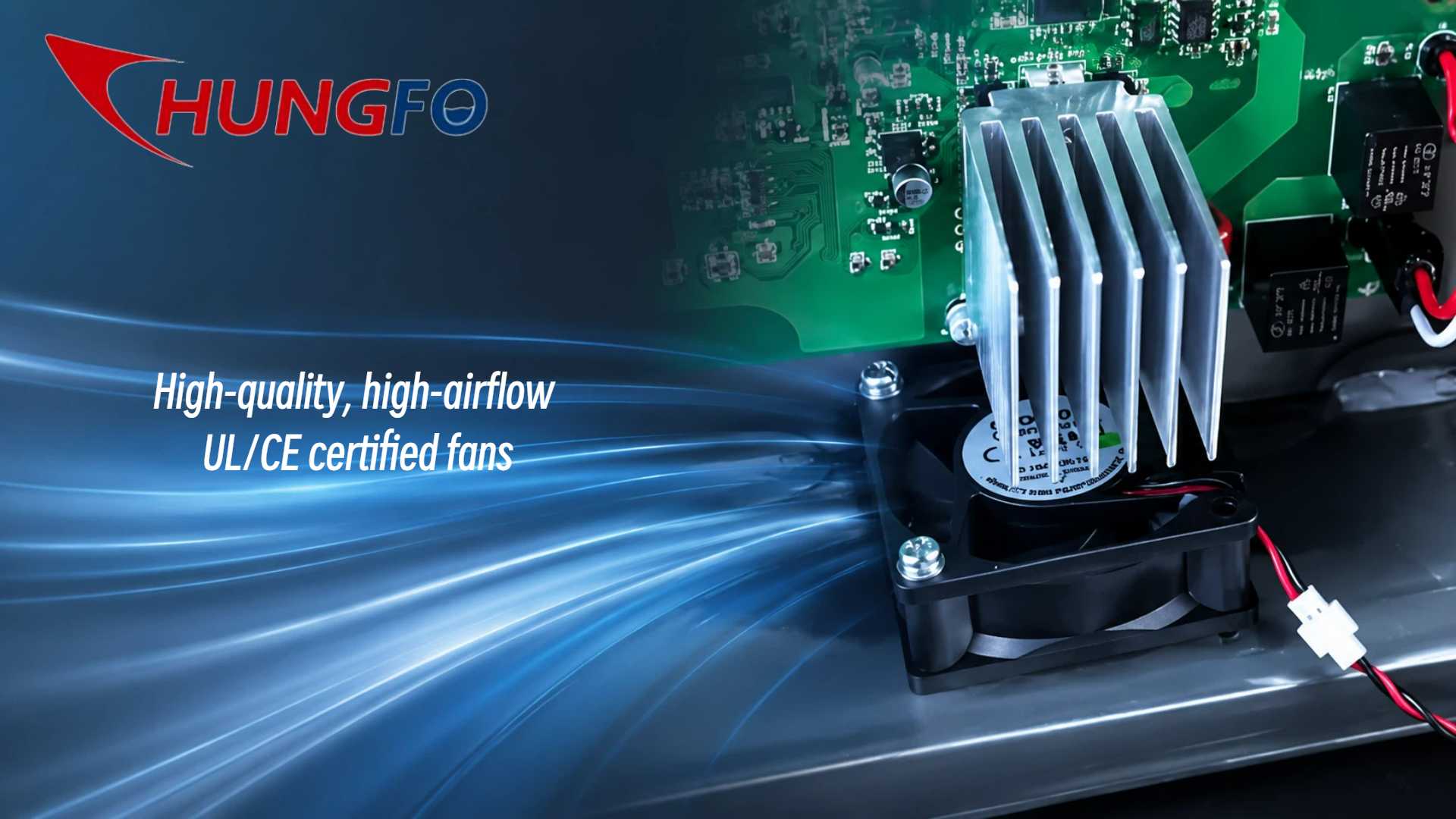
How Do Commutation Circuits Dictate The Cooling Fan Working Principle In PCB Boards?

July 31 , 2026

As modern electronic devices become more compact and computationally powerful, thermal management has become one of the most critical design considerations. Printed Circuit Boards (PCBs) are now expected to support increasingly dense electronic components, high-speed processors, AI modules, communication chips, and power management systems, all of which generate substantial heat.

Among the many thermal solutions available, the cooling fan remains one of the most effective and economical methods for maintaining safe operating temperatures. However, the performance of a cooling fan is determined by much more than its blade design or motor size. One of the most important yet frequently overlooked factors is the commutation circuit inside the brushless DC motor.

Understanding how commutation circuits influence the cooling fan working principle helps engineers choose the right fan for PCB applications while improving system reliability, efficiency, and service life.

Whether designing industrial control equipment, communication hardware, medical devices, or consumer electronics, understanding this relationship is essential.

This article explains the cooling fan working principle from the perspective of electronic commutation circuits while discussing practical PCB cooling solutions used in modern electronic manufacturing.

35mm DC Fan


Why PCB Cooling Has Become More Important Than Ever

The average PCB today carries significantly more processing power than boards produced only a decade ago. Components continue shrinking while power density keeps increasing.

Common PCB heat sources include:

Microprocessors

Power MOSFETs

Voltage regulators

FPGA chips

Communication ICs

LED drivers

Power supplies

Industrial controllers

Excessive heat affects every electronic component differently, but the overall consequences remain similar.


Reduced component lifespan

Unexpected system shutdowns

Clock throttling

Communication errors

Solder joint fatigue

Premature capacitor aging

Lower product reliability

Because passive heat sinks eventually reach their thermal limits, active airflow provided by a PCB cooling fan often becomes necessary.


Understanding The Cooling Fan Working Principle

A modern brushless DC cooling fan consists of several key components.

Rotor with permanent magnets

Stator windings

Hall-effect sensors

Driver IC

Electronic commutation circuit

Fan blades

Unlike brushed motors, brushless motors have no carbon brushes making physical electrical contact with the rotor.

Instead, an electronic commutation circuit continuously switches current through multiple stator windings according to rotor position.

This switching process creates a rotating magnetic field.

The permanent magnet rotor follows this rotating magnetic field, causing the blades to rotate and generate airflow.

Although the process appears simple from the outside, the quality of electronic commutation directly determines how efficiently the fan operates.


What Is An Electronic Commutation Circuit?

The commutation circuit functions as the brain of every brushless cooling fan.

Its primary responsibilities include:

Detecting rotor position

Switching current timing

Controlling motor startup

Maintaining rotational stability

Reducing vibration

Protecting against locked rotor conditions

Managing PWM speed control

Modern driver ICs integrate many of these functions into compact semiconductor packages, making today's brushless fans far more efficient than previous generations.

Without electronic commutation, the motor simply cannot rotate.


How Hall Sensors Guide Commutation

Many PCB cooling fans use Hall-effect sensors.

Hall sensors continuously detect the magnetic field generated by the rotor magnets.

The sensor sends position information to the driver IC.

The commutation circuit then energizes the correct stator winding.

Milliseconds later, rotor movement changes magnetic position again.

The cycle repeats thousands of times every second.

This constant switching creates smooth continuous rotation.

Accurate Hall sensing leads to:

Stable RPM

Lower vibration

Reduced acoustic noise

Improved efficiency

Lower starting voltage

Higher reliability

Sensorless Commutation Technology

Some compact fans eliminate Hall sensors entirely.

Instead, sensorless drivers monitor the back electromotive force generated by stator windings.

Advantages include:

Lower manufacturing cost

Simpler construction

Smaller size

Higher reliability under vibration

However, sensorless designs may have reduced startup torque under extremely low speeds.

For many miniature electronics, either solution performs exceptionally well depending on application requirements.


How Commutation Circuits Affect Airflow

Many engineers assume blade design alone determines airflow.

In reality, airflow depends heavily on motor control quality.

Poor commutation causes:

Torque ripple

RPM fluctuation

Vibration

Magnetic imbalance

Reduced efficiency

Higher power consumption

Airflow instability

A high-quality commutation circuit minimizes these effects by providing extremely precise current switching.

The result is smoother blade rotation and more consistent cooling.

This becomes particularly important when selecting a Small DC Fan for sensitive electronic assemblies.

A stable airflow profile prevents localized hot spots while improving thermal consistency across the PCB.


Why Precision Matters In PCB Cooling

Electronic components often operate within narrow temperature margins.

For example:

Industrial PLC controllers

Medical electronics

Telecommunication switches

Network routers

AI edge computing devices

Embedded systems

Consumer smart appliances

Even small airflow fluctuations may increase junction temperatures enough to reduce long-term reliability.

This explains why professional engineers pay close attention to motor driver quality rather than focusing solely on airflow specifications.


PWM Speed Control And Smart Commutation

Modern electronic systems rarely require cooling fans to operate at maximum speed continuously.

Instead, many systems implement PWM control.

The motherboard monitors temperature.

The controller sends PWM signals.

The commutation circuit adjusts motor speed.

Benefits include:

Lower power consumption

Reduced noise

Longer bearing life

Improved thermal efficiency

Better user experience

Accurate PWM control depends heavily on sophisticated commutation algorithms.

Poor motor drivers may produce unstable speeds under low PWM duty cycles.


The Role Of Miniature Fans In PCB Design

Compact electronics increasingly rely on miniature cooling fans.

One common solution is the 30mm cooling fan.

These ultra-small fans are frequently installed inside:

Industrial gateways

Mini PCs

Embedded controllers

Power modules

Communication equipment

Medical analyzers

Battery charging systems

Small dimensions allow designers to place airflow exactly where heat accumulates most.

Despite their compact size, modern miniature brushless fans can deliver impressive airflow thanks to optimized blade geometry combined with advanced commutation circuits.


Choosing The Right PCB Cooling Fan

Selecting a PCB cooling fan involves balancing numerous design considerations.

Airflow requirements

Static pressure

Noise level

Operating voltage

Power consumption

Bearing type

PWM compatibility

Locked rotor protection

Life expectancy

EMI performance

Environmental temperature

Ingress protection

Ignoring motor electronics while focusing only on CFM often leads to disappointing system performance.

A properly engineered PCB cooling fan combines efficient aerodynamics with highly optimized electronic commutation.


Common PCB Cooling Applications

Brushless cooling fans are widely used across modern industries.

Industrial automation

Telecommunication equipment

Medical devices

Server systems

AI computing hardware

Electric vehicle charging stations

Solar inverter control boards

Consumer appliances

Smart home electronics

Security equipment

Professional audio systems

Every application demands reliable airflow while maintaining low power consumption and quiet operation.


Manufacturing Quality Determines Fan Reliability

Even the most advanced commutation circuit performs poorly if manufacturing quality is inconsistent.

Professional cooling fan manufacturers invest heavily in automated production and testing systems.

Critical inspections typically include:

Dynamic balancing

Airflow testing

Noise analysis

High-temperature aging

Low-temperature startup

Locked rotor testing

Electrical safety verification

Life cycle testing

Every production stage influences long-term reliability.


Why Choose Chungfo Fan

As electronic products become more intelligent, cooling solutions require higher precision than ever before.

Chungfo Fan specializes in the development and manufacturing of high-performance brushless cooling fans for global OEM and industrial customers.

The company provides comprehensive thermal management solutions covering miniature fans, axial fans, centrifugal blowers, cross flow fans, AC fans, EC fans, and customized cooling systems.

Its manufacturing facility integrates product design, mold development, injection molding, SMT production, automated assembly, and comprehensive quality inspection under one production system.

Every cooling fan undergoes rigorous testing, including dynamic balance analysis, airflow measurement, noise evaluation, high and low temperature testing, salt spray resistance testing, electrical performance verification, and long-term reliability validation.

Serving industries such as industrial automation, medical equipment, communication systems, smart home appliances, refrigeration equipment, renewable energy, electric vehicle charging infrastructure, and intelligent electronics, Chungfo Fan continues to provide dependable thermal management solutions that meet the demanding requirements of modern PCB applications.


Future Trends In Electronic Commutation

Motor control technology continues evolving rapidly.

Future PCB cooling fans are expected to incorporate:

AI-assisted speed optimization

Digital communication interfaces

Predictive failure monitoring

Lower electromagnetic interference

Higher efficiency driver ICs

Adaptive airflow algorithms

Integrated temperature sensing

Ultra-low power standby modes

As electronics become increasingly compact, intelligent commutation circuits will play an even greater role in maintaining thermal stability while reducing energy consumption.


Conclusion

The cooling fan working principle extends far beyond spinning blades. At the heart of every modern brushless fan lies an electronic commutation circuit that determines motor efficiency, airflow stability, noise, reliability, and service life.

For PCB thermal management, selecting a high-quality Small DC Fan, an efficient 30mm cooling fan, or a dependable PCB cooling fan means evaluating both aerodynamic performance and electronic motor control. Superior commutation technology ensures stable airflow, lower power consumption, and longer operational life, helping electronic devices perform reliably even under demanding thermal conditions.

With extensive manufacturing experience, advanced production capabilities, and rigorous quality control, Chungfo Fan continues to deliver innovative cooling solutions that support the next generation of high-performance electronic systems.

私たちのメーリングリストのためにサインアップすることによって知らされたまま
伝言を残す
伝言を残す
あなたは私達のプロダクトに興味があり、詳細を知りたいのですが、ここにメッセージを残してください

在宅

プロダクト

whatsapp